


Dual hose vs single hose AC: which one actually cools better?
Dual-hose portable air conditioners normally cool a room faster and use less electricity than single-hose models, because they draw combustion air from outside rather than sucking it out of the room they’re meant to be cooling. That single design choice avoids negative pressure, which is the main reason dual-hose units close the “single hose vs dual hose ac” performance gap so decisively in independent testing.
That said, a single-hose unit still makes sense for some households. If you’re moving a unit between rooms every week, live in a small flat with only one window, or only need occasional cooling on the hottest days of the year, the efficiency loss may not outweigh the lower price and simpler setup.
Quick scenarios to help you decide:
- Choose dual-hose if you run the unit for long stretches, live in an older or draughtier property, or need to cool a larger room quickly.
- Choose single-hose if you need portability between rooms, have a tight budget, or only use the unit occasionally.
- Consider a conversion or accessory kit if you already own a single-hose unit and want to claw back some efficiency without buying new.
Independent tests reported by HVAC Base put the effective cooling gap between the two designs at 10% to 40%, depending on room conditions. Simcodirect stocks both cooling and heating equipment for UK homes, and Carl, who put this guide together, has drawn on manufacturer testing standards and independent lab comparisons rather than marketing claims to keep the advice grounded.
Key Takeaways
Dual-hose portable air conditioners avoid the negative pressure that saps single-hose efficiency, delivering meaningfully lower running costs for anyone using a unit regularly.
| Point | Details |
|---|---|
| Dual-hose wins on efficiency | Independent testing shows a 10% to 40% effective cooling advantage over single-hose units of similar rated capacity. |
| Ignore the BTU figure | Compare SACC and CEER instead, since BTU doesn’t reflect real-world hose losses or negative pressure. |
| Running costs are calculable | UK electricity at 22p/kWh puts hourly costs between 13p and 29p depending on unit wattage and hose type. |
| Match the unit to the room | Larger rooms, longer daily use, and draughtier or very airtight buildings all favour dual-hose designs. |
| Conversion has limits | Aftermarket conversion kits can recover some efficiency but rarely match a purpose-built dual-hose unit, and may affect warranty. |
| Simcodirect supports the setup | Simcodirect stocks compatible window kits, hoses, and condensate fittings, backed by fast UK delivery and 30-day returns. |
Table of Contents
- Single hose vs dual hose AC: how the airflow actually works
- Dual hose cooling efficiency and what it costs to run
- How room size, building age and habits change the outcome
- Installing a portable AC and whether conversion kits work
- What to check before you buy: sizing and feature checklist
- Keeping a portable AC running well: maintenance, condensate and noise
- Why Simcodirect backs SACC and CEER over marketing BTU
- What matters most when you’re actually choosing
- Get your portable AC setup right with Simcodirect
- Sources
Single hose vs dual hose AC: how the airflow actually works
The difference between these two designs comes down to where the air comes from, not just where it goes.
A single-hose unit pulls air from inside your room, passes it over a hot condenser coil to cool the internal components, and pushes that heated air outside through one hose. The catch is that the air being expelled has to be replaced by something. Since the unit only has one hose, it can’t pull in outside air to make up the difference, so it draws replacement air from wherever it can find a gap: under doors, through window frames, around loft hatches, even through electrical sockets in older properties. That incoming air is warm, often humid, and it’s exactly what the unit is working to cool in the first place.
This is what engineers call negative pressure, and New Scientist has described it plainly: single-hose portable air conditioners use room air to cool their own internal components and exhaust it outside, which drags warm replacement air back into the space and cuts net cooling effectiveness. Your unit ends up chasing its own tail, cooling air that keeps getting topped up with heat from outside.
A dual-hose unit sidesteps the problem entirely. One hose draws outside air in specifically to cool the condenser coil, and the second hose exhausts that same air back outside once it’s done its job. The air you’re actually breathing and cooling inside the room never gets pulled into the exchange loop at all. No air debt, no replacement infiltration, no reheating cycle.
Both designs still rely on the same basic vapour-compression refrigeration cycle used in fridges and split systems, just with different intake logic bolted on. If you want the mechanical basics, Wikipedia’s overview of vapour-compression refrigeration is a solid neutral reference.
In tighter, more modern buildings, the negative pressure problem gets worse rather than better. Newer homes are built to trap heat in winter, which means they’re also very good at resisting outside air movement in summer. When a single-hose unit forces its way against that airtightness, it can pull warm air through service penetrations, extractor fan ducts, and even plug sockets, and the effect intensifies on windy days when pressure differences across the building envelope grow larger.
Pro Tip: Before buying, check how the hose connects to the unit and the window kit. A short, straight run with a tightly sealed bracket loses far less cooling than a long hose bent at sharp angles, and gaps around the window kit are one of the most common reasons a “faulty” unit is actually just leaking cool air straight back outside.
- Look for a snug foam or brush seal around the window bracket, not just a loosely fitted panel.
- Check the hose length supplied. Longer than around 1.5 to 2 metres often reduces airflow efficiency.
- If buying dual-hose, confirm both hoses are the same diameter. Mismatched hoses are a sign of a cheaper conversion kit rather than a purpose-built design.
Dual hose cooling efficiency and what it costs to run
The efficiency gap between these two designs isn’t marginal. It’s consistently large enough to change which one you should buy.
HVAC Base’s side-by-side testing found dual-hose units deliver 10% to 30% more effective cooling than single-hose equivalents of similar rated capacity, while broader aggregated testing cited by Portable-Air-Conditioner-Guru puts the real-world gap at 20% to 40% once you factor in negative pressure infiltration in typical rooms. That’s a wide range, but the direction is consistent across every source: dual-hose wins, and it isn’t close.
Part of that gap comes down to how hard the compressor has to work. Manufacturer lab data referenced by HVAC Base shows dual-hose units run their compressors for a smaller proportion of the time needed to reach and hold a target temperature, because they aren’t constantly fighting an influx of warm replacement air. Less compressor duty cycle means less electricity draw over the course of a day, not just faster initial cooling.
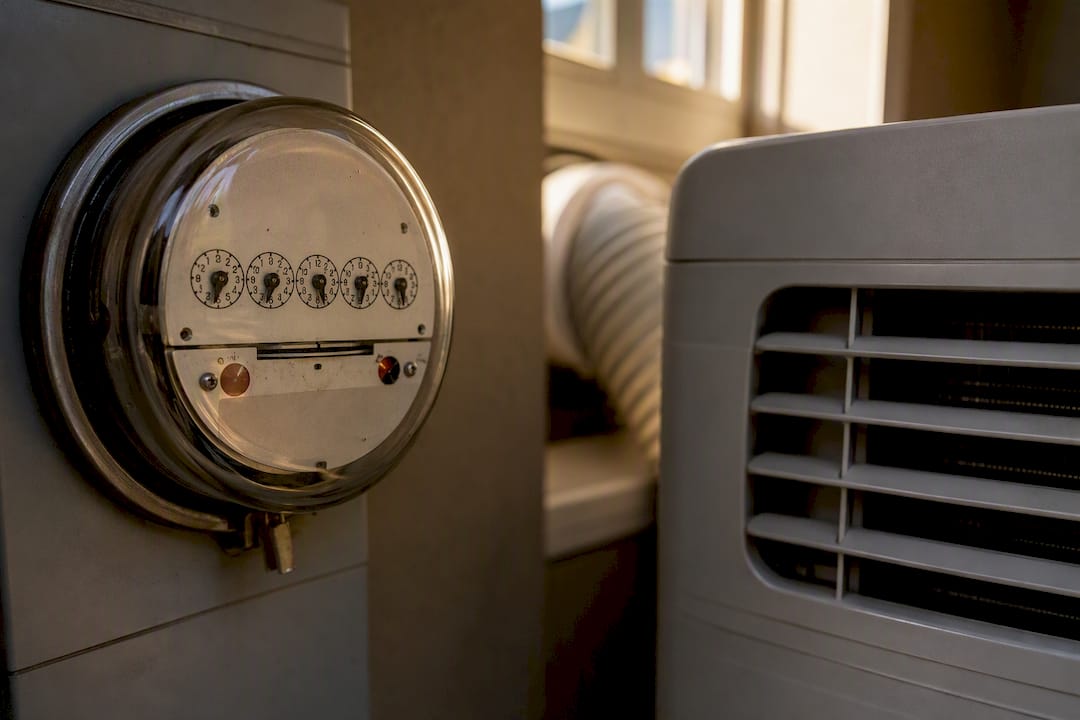
This is also why the BTU figure printed on the box is close to useless for comparing portable units. BTU (British Thermal Units) measures raw heat output under laboratory conditions that rarely reflect how a portable AC performs once negative pressure and hose losses are factored in. Two units with identical BTU ratings can perform very differently in your living room depending on whether they’re single-hose or dual-hose. If you want the full breakdown of why BTU numbers mislead buyers, Simcodirect’s guide to what BTU actually measures is worth a read before you shop.
Two figures are far more reliable: SACC (Seasonally Adjusted Cooling Capacity) and CEER (Combined Energy Efficiency Ratio). SACC is a standardised test measure that accounts for the energy the unit itself consumes and the reduced cooling effect caused by hose configuration, giving a realistic picture of what you’ll actually feel in the room. CEER goes a step further and expresses cooling output per watt of electricity consumed, factoring in standby power draw too. A model with a high CEER and a strong SACC rating relative to its room size claim is a genuinely better buy than one boasting a big BTU number on the packaging.
What this means in pounds and pence. Homebuilding’s research puts typical portable AC running costs between 13p and 29p per hour, based on an average UK electricity rate of 22p per kilowatt hour and power draw of 600W to 1,300W depending on unit size. Run a mid-range unit for an 8-hour day and you’re looking at somewhere between £1.04 and £2.32 in electricity, purely for that one day.
To work out your own likely running cost:
- Check the unit’s rated wattage (usually on the spec sheet, not the box front).
- Multiply by your expected daily hours of use.
- Divide by 1,000 to convert watt-hours to kilowatt-hours.
- Multiply by your electricity tariff rate (22p/kWh as a reasonable UK average, though check your own tariff).
- If it’s single-hose, add roughly 20% to 30% to account for the extra compressor runtime caused by infiltration losses.
If you’re weighing this up against a permanently installed alternative, Simcodirect’s guide to inverter air conditioner benefits walks through comparable hourly running costs for fixed systems, which is a useful sanity check if you’re on the fence between a portable unit and something more permanent.
How room size, building age and habits change the outcome
The “right” choice between single hose and dual hose portable AC isn’t fixed. It shifts depending on your room, your building, and how often you’ll actually run the thing.
Dual-hose is the clear winner when any of the following apply to your situation:
- You’re cooling a room larger than around 20 square metres, where the volume of replacement air a single-hose unit needs to pull in becomes significant.
- Your home is older or draughtier, which sounds like it should favour single-hose (more natural air movement) but actually makes the infiltration problem worse because warm, sometimes damp air gets pulled in from uncontrolled gaps rather than a filtered second hose.
- You run the unit for more than four or five hours a day, since the compressor duty-cycle savings compound over longer sessions.
- You live somewhere with hot, humid summers, where the outside air a single-hose unit drags in carries extra latent heat that the compressor then has to work harder to remove.
Single-hose remains a perfectly reasonable choice in narrower circumstances:
- You need to move the unit between two or three rooms depending on the day, and dragging two hoses through a doorway each time isn’t practical.
- Your usage is genuinely occasional, perhaps a handful of very hot days each summer, where the extra 20% to 40% running cost doesn’t add up to much in absolute terms.
- Budget is the deciding factor and a dual-hose model with comparable SACC rating isn’t within reach.
Building airtightness matters more than most buyers expect. A Victorian terrace with original sash windows and gaps around skirting boards will “feed” a single-hose unit’s air debt more easily than a newly built flat with double glazing and cavity wall insulation, but that supply of replacement air is completely uncontrolled. It brings in outdoor humidity, dust, and heat rather than filtered, cooled air. A tightly sealed modern building actually makes the negative pressure problem worse in a different way: there’s nowhere for replacement air to come from except forced infiltration through service gaps, which can create a faint but persistent draught around sockets and skirting on the room’s exterior walls.
Wind direction and exposure play a role too. A room on the windward side of a building experiences stronger pressure differentials, which pushes more air through gaps and amplifies whatever effect the AC’s negative pressure is already causing. South and west-facing rooms with heavy afternoon sun exposure also need more raw cooling capacity regardless of hose configuration, so factor orientation into your sizing decision alongside floor area.
As a rough practical guide: small bedrooms up to around 15 square metres with reasonable insulation can often manage on a single-hose unit if usage is intermittent. Living rooms, open-plan kitchen diners, or anything above 20 to 25 square metres, particularly with high ceilings or large glazed areas, are where dual-hose configurations consistently prove their worth, a finding Portable-Air-Conditioner-Guru’s field reporting backs up repeatedly.
Installing a portable AC and whether conversion kits work
Getting the installation right matters almost as much as which hose configuration you buy, because a poorly sealed window kit can undo most of the efficiency advantage a dual-hose unit is supposed to give you.
Most window kits are designed to fit standard sliding sash or casement windows, typically accommodating a gap of around 40cm to 150cm depending on the adjustable panel, with a circular or slotted opening for the hose (or hoses) to pass through. Dual-hose units need two such openings, either as separate holes in the panel or, more commonly now, a single wider bracket with two integrated ports. Measure your window opening before you buy. Not every kit fits every window style, particularly older timber sash windows or uPVC frames with unusual profiles.
Getting the installation right comes down to a handful of practical steps:
- Keep the hose run as short and as straight as possible. Every bend and every extra metre reduces airflow and increases the load on the compressor.
- Make sure the window bracket seals fully around its edges. Gaps here let outside heat back in exactly where you’re trying to exhaust it.
- Position the unit so the air intake at the back isn’t blocked by curtains, furniture, or a wall closer than about 30cm.
- For dual-hose units, keep the two hoses separated rather than twisted together, as this reduces the chance of one restricting airflow to the other.
On the question of converting a single-hose unit into a dual-hose setup: aftermarket conversion kits do exist, adding a second intake hose to draw outside air into the condenser rather than pulling it from the room. Results vary considerably, because most single-hose units aren’t designed with a second port in mind, so the conversion often means cutting into the casing or improvising a seal around the compressor housing. Where it works, buyers typically report a partial recovery of the efficiency lost to negative pressure, but rarely the full gain a purpose-built dual-hose unit delivers. It’s also worth flagging that opening the casing on some models will void the manufacturer’s warranty, and any home-made seal around a hot compressor introduces a fire risk if it isn’t done properly. If your current unit is still under warranty, check the terms before attempting any modification.
Pro Tip: If you’re only running your existing single-hose unit occasionally, a well-fitted window kit and a shorter, straighter hose run will often close more of the efficiency gap than a full conversion kit, at a fraction of the cost and none of the warranty risk.
What to check before you buy: sizing and feature checklist
Sizing a portable AC correctly starts with the room, not the unit spec sheet.
Measure your floor area in square metres, then factor in ceiling height. A room with a 2.4-metre ceiling needs less raw capacity than the same footprint with a 3-metre vaulted ceiling. Add a margin if the room gets strong afternoon sun, sits above a kitchen, or houses heat-generating equipment like a home office setup with multiple monitors and a desktop tower.
Once you’ve got a rough size in mind, the label numbers you should actually compare are SACC and CEER, not the advertised BTU figure. Simcodirect’s guide for commercial buyers covers why SACC gives a more honest picture of real-world output, and the same logic applies just as much to a single household bedroom as it does to a commercial site. E320 Air’s breakdown of SACC versus BTU makes a similar case, worth reading if you want a second technical opinion before you commit to a model.
Beyond the headline efficiency figures, run through this checklist before comparing specific models:
- Hose configuration: single or dual, and does the dual-hose version have genuinely separate intake and exhaust ports rather than a shared vent?
- Condensate handling: internal tank requiring manual emptying, or a continuous drain hose option for humid climates?
- Noise rating: check the decibel figure at the operating mode you’ll actually use, not just the lowest fan speed.
- Filter type: washable mesh filters are cheaper long-term than proprietary replacement cartridges.
- Warranty length: anything under 12 months on the compressor is a red flag on a unit of this price bracket.
One market reality worth knowing: single-hose units dominate shelf space in many retailers, and that’s largely down to lower manufacturing cost and simpler installation rather than better performance, a point New Scientist makes explicitly. Availability isn’t the same as quality. If a shortlist of models all look similar on BTU, use SACC and CEER to break the tie, and don’t assume the most common option on the shelf is the most efficient one.
Keeping a portable AC running well: maintenance, condensate and noise
A portable AC that’s badly maintained loses efficiency fast, regardless of which hose configuration you bought.
Condensate management is the first thing to get right. Units with an internal tank need emptying periodically, typically every 8 to 12 hours of continuous use in humid conditions, though this stretches out considerably in drier weather. Many mid-range and higher-capacity models offer a continuous drain hose option instead, which routes condensate straight outside and removes the emptying chore entirely, something Trusted Reviews flags as a meaningful convenience difference between models. If you live somewhere humid or plan to run the unit for long stretches unattended, prioritise a model with drain hose compatibility.
Filters need regular attention too. A dust-clogged filter forces the unit to work harder to pull air through it, which quietly increases running costs and reduces cooling output without any obvious fault developing. Check and clean the filter every two weeks during heavy summer use, more often if you have pets or live somewhere dusty.
On noise, most portable units run somewhere between 42 and 60 decibels depending on fan speed and compressor load, roughly comparable to a running dishwasher at the quieter end and a loud conversation at the noisier end. Placement helps more than people expect: standing the unit on a hard floor rather than carpet reduces vibration transfer, and keeping it a few centimetres from a wall stops sound reflecting back into the room. If noise is a priority for a bedroom or home office, Simcodirect’s guide to quiet home office cooling options covers placement tricks specifically for smaller, noise-sensitive spaces.
If cooling feels weaker than it used to, run through this quick troubleshooting list before assuming the unit’s faulty:
- Check the hose for kinks, tears, or a loose connection at either end.
- Clear the intake grille of dust, pet hair, or nearby furniture blocking airflow.
- Clean or replace the filter if it hasn’t been done in the last fortnight.
- Confirm the thermostat sensor isn’t sitting in direct sunlight or near another heat source, which can trick it into under-cooling the room.
Why Simcodirect backs SACC and CEER over marketing BTU
Carl, who put this guide together, spent time cross-referencing manufacturer testing standards against the independent lab comparisons cited throughout this article rather than relying on box copy, because portable AC marketing has a well-documented habit of leading with the most flattering number rather than the most useful one.
The pattern that stands out across every independent test referenced here is consistent: SACC and CEER predict real-world comfort far better than BTU ever does, and the 20% to 40% cooling gap between single-hose and dual-hose designs shows up again and again regardless of who ran the test.
Simcodirect’s own product pages lean on this same principle when listing AC and heating equipment, prioritising the figures that actually predict how a unit performs in a real UK home over headline numbers that look good on packaging. For further reading on related sizing questions, Simcodirect’s guides on what BTU actually measures and choosing portable units for larger sites cover adjacent ground worth reading before you buy.
Beyond the units themselves, Simcodirect stocks a range of accessories that matter once you’ve got a portable AC installed: window sealing kits, replacement and extension hoses, and condensate drain fittings for units that support continuous drainage. Always check individual product pages for compatibility with your specific unit’s hose diameter and connector type before ordering, since fittings vary between manufacturers. Combined with fast UK delivery and a 30-day returns policy on eligible items, it’s a straightforward way to sort out the accessory side of a portable AC setup without hunting across multiple retailers.
What matters most when you’re actually choosing
Most buying guides treat this as a simple upgrade decision: dual-hose is better, so buy dual-hose, end of story.
If you’re running a unit for three hot weeks a year in a small rented flat, chasing the theoretically superior design misses the point entirely. Portability and upfront cost win that argument. But if you’re cooling a living room every evening from May to September, the running cost gap compounds fast, and a single-hose unit’s lower price tag stops looking like a saving after the first summer.
The number I’d tell any reader to actually check before buying anything is SACC, not BTU and not even the hose count on its own. A well-rated single-hose unit with strong SACC can still beat a poorly built dual-hose model. Get the room sizing right first, then let hose configuration settle the efficiency question.
— Carl
Get your portable AC setup right with Simcodirect
Choosing between single-hose and dual-hose is only half the job. Getting the installation accessories right is what actually determines whether you see the efficiency gains this guide has walked through. Simcodirect stocks the window kits, hoses, and heating accessories that make a portable AC setup work properly in a UK home, backed by fast delivery and a 30-day returns policy if something isn’t the right fit.
Beyond cooling accessories, Simcodirect’s range covers the wider jobs a home upgrade project usually needs alongside it: designer radiators, electric heaters, and towel rails for the rest of the house once summer’s over. If you’re upgrading a bathroom or utility space at the same time as sorting your cooling setup, the Consort Toweldry Towel Radiator is worth a look for a practical, efficient addition to any bathroom refurbishment. Browse the current range, check stock and delivery times, and get your order in before the next heatwave catches you unprepared.
Sources
The claims in this guide draw on a small set of sources chosen for technical depth rather than marketing content.
- How does a portable air conditioning unit work? | Homebuilding
- Single-Hose vs Dual-Hose Portable AC: Which Is Better? | HVAC Base
- Most portable air conditioners suck — but there’s an easy fix | New Scientist
- How do portable air conditioners work? | Trusted Reviews
- Dual-hose vs single-hose portable AC: the 20-40% cooling gap renters keep ignoring