


Air purifier placement: best spots for every room
Place your air purifier 1.8–3 metres from the head of your bed, elevated to roughly mattress height, with at least 20–30 cm of clearance on all sides. That single rule, applied tonight, will put clean filtered air into the zone you actually breathe for the next eight hours. Everything else in this guide refines that starting point for different rooms, pollutants, and purifier types.
Quick placement checklist:
- Keep 20–30 cm of clear space from walls and furniture on every side. Independent testing shows airflow drops to roughly 5% of rated output when a unit sits flat against a wall.
- Position the unit 1.8–3 m from the head of the bed, elevated to mattress height so clean air reaches your breathing zone without a direct draught.
- Keep the bedroom door closed while the purifier runs. A closed room allows the unit to cycle the same air repeatedly, reaching lower particle concentrations than an open space ever will.
Avoid these from the start: corners, the space behind sofas or curtains, directly on the floor with no clearance, and any position beside an open window.
Key takeaways
| Point | Details |
|---|---|
| Bedroom-first rule | Place 1.8–3 m from the head of the bed, elevated to mattress height, door closed. |
| Wall clearance | Maintain 20–30 cm on all sides; flat-against-wall placement drops airflow to roughly 5% of rated output. |
| CADR sizing | Use the AHAM 2/3 rule: smoke CADR should be at least two-thirds of room area in square feet. |
| Pollutant-driven position | Elevate for fine pollen and PM2.5; floor level for heavy pet hair; near doorway for cooking particles. |
| Simcodirect | Stocks air purification systems with fast UK delivery; confirm CADR, HEPA rating, and filter availability before buying. |
Table of Contents
- What factors change the best air purifier location?
- Room-by-room guide: where to place your air purifier
- Common placement mistakes that cut performance in half
- How CADR and the AHAM ‘2/3’ rule affect your placement decisions
- Hands-on setup checklist: confirming good placement
- Diagnosing weak performance and keeping filters fresh
- How your primary pollutant changes the best spot
- Why most people get bedroom placement wrong
- Simcodirect stocks air treatment products with fast UK delivery
- Sources
What factors change the best air purifier location?
Room size is the first variable. A purifier rated for 20 m² will clean a 12 m² bedroom with room to spare, but the same unit in a 35 m² open-plan living room will only scrub the air in its immediate vicinity. The relevant metric is CADR (Clean Air Delivery Rate), which measures how quickly a unit delivers filtered air in cubic feet or cubic metres per minute. A higher CADR gives you more tolerant placement because the unit’s effective reach extends further from the device.
Airflow profile matters more than most buyers realise. A unit with a rear intake and front output needs to face into the room, not a wall. A 360° intake model can sit more centrally because it draws air from all sides. If you own a tower-style unit with a top outlet, elevating it slightly and angling the output toward your seating or sleeping position makes a measurable difference.
Noise is the other variable that shapes bedroom placement specifically. Running a purifier on its highest fan speed from 1 metre away will disturb sleep. The practical fix is distance: move the unit 2–3 metres from the bed and run it on high before you sleep, then drop to night mode once you get in. That distance-for-quiet trade-off is worth making rather than running the unit quietly from close range all night.
Practical constraints to check before you commit to a spot:
- Power outlet proximity: avoid trailing cables across walkways.
- Pet and child safety: floor-placed units with exposed intakes can attract curious hands and paws.
- Filter-change access: leave enough space to remove the front or bottom panel without moving the whole unit.
Pro Tip: If your purifier has an air quality indicator, watch it for 20 minutes after you place the unit. If the reading barely improves, the spot is wrong, not the device.
Room-by-room guide: where to place your air purifier
Bedroom
The breathing zone is the priority. Place the unit 1.8–3 m from the head of the bed, elevated to mattress height on a bedside table or low shelf. Avoid pointing the output directly at your face; angle it slightly upward or toward the ceiling so clean air circulates rather than blasts. Keep the door closed while the unit runs. If you are concerned about allergens drifting in from a hallway, positioning the unit near the bedroom door intercepts incoming particles before they reach the bed.
Living room
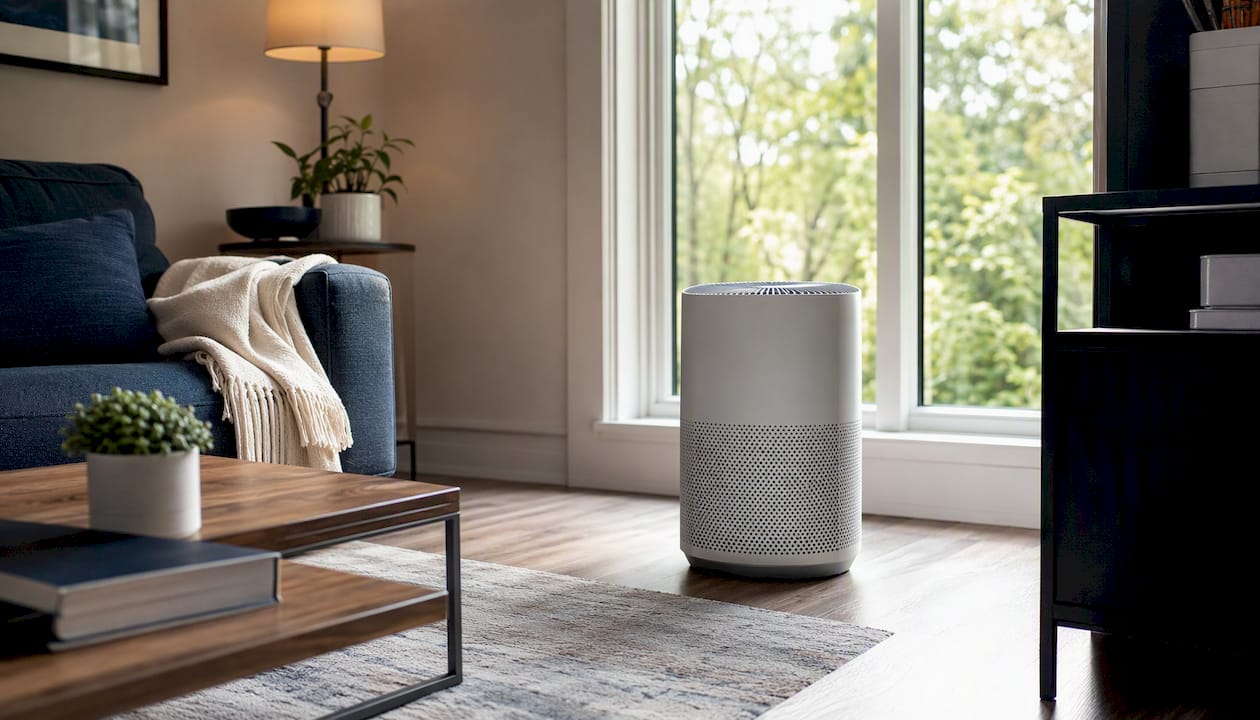
Central placement, or close to the main seating area, works best. The goal is to clean the air where people actually sit, not the air in the far corner behind the television. Avoid tucking the unit behind a sofa or inside a media unit; both obstruct intake and output. If your living room has a high ceiling or open-plan layout, consider a unit with a higher CADR or a second unit at the far end of the space.
Kitchen
Cooking generates fine particulate matter, grease aerosols, and nitrogen dioxide. Position the purifier near the kitchen doorway or at the edge of the room to intercept cooking particles as they spread, but keep it away from the hob itself. Grease deposits clog HEPA filters rapidly, and heat from the stove can damage sensors. A unit with a dedicated activated-carbon layer handles cooking odours better than a HEPA-only model. Your extractor fan remains the primary defence; the purifier supplements it.
Home office
Place the unit within 1–2 metres of your desk, at or slightly above seated head height. Avoid positioning it directly beside a laser printer; printers emit ultrafine particles and ozone, which will overload the filter faster than normal use. A small-to-medium CADR unit is usually sufficient for a single-occupancy office.
Basement and damp spaces
A persistently damp basement is a poor environment for most air purifiers. High humidity accelerates mould growth on HEPA filters and can damage electronics. Place the unit just outside the basement entrance, or choose a model specifically rated for damp conditions. For context on why mechanical ventilation matters in damp spaces, the role of bathroom extractor fans applies equally here: a purifier does not substitute for proper ventilation.
Pet areas
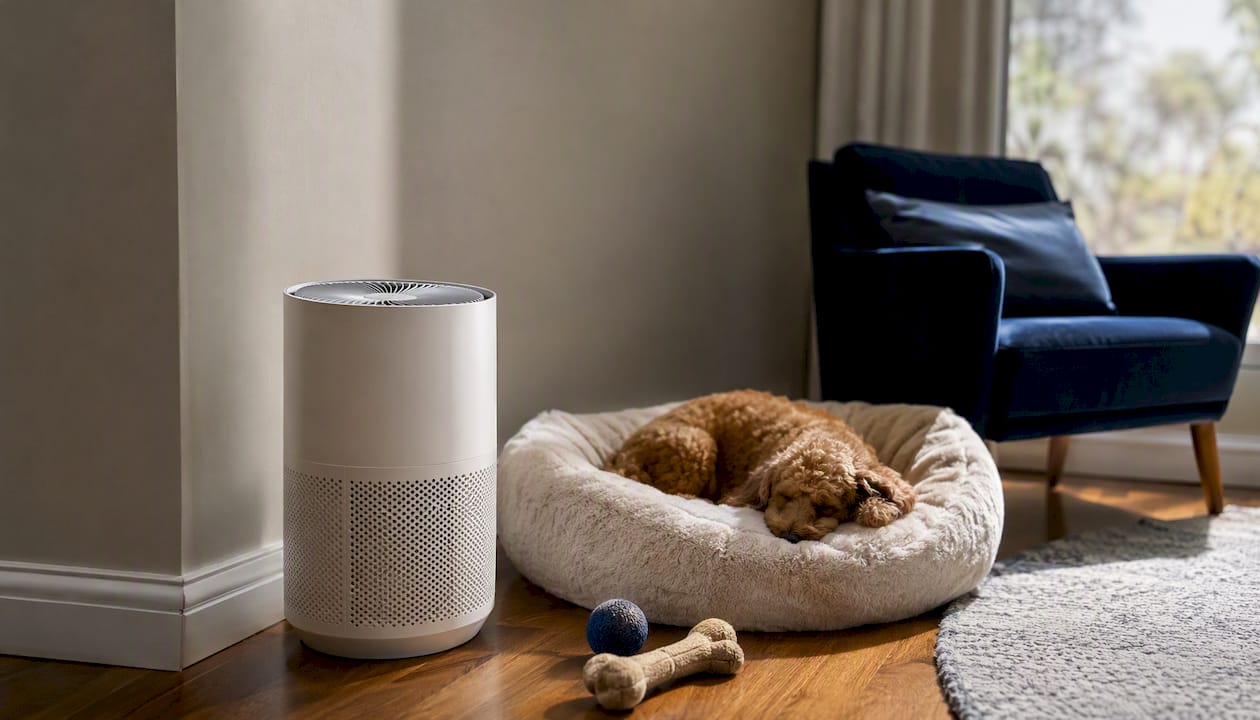
Place the unit close to where your pet sleeps or near the litter box, but maintain at least 30 cm of clearance. Pet dander is relatively heavy and settles quickly, so floor-level placement captures it more effectively than an elevated position. For fine allergens like cat saliva proteins, which become airborne when dander dries, a slightly elevated unit works better. If you have multiple pets or a large space, a second unit near the main living area is worth considering.
Common placement mistakes that cut performance in half
Flat against a wall or in a corner. This is the single most damaging placement error. Blocking the intake or exhaust reduces effective performance by 20–50% compared with open-room placement. The minimum fix is 20–30 cm of clearance on all sides.
Behind furniture or curtains. A purifier tucked behind a sofa or inside a curtain fold only cleans the air in that small pocket. The rest of the room stays untouched. If the unit is out of sight, it is almost certainly in the wrong place.
Next to an open window. Continuous outdoor air ingress means the unit is constantly processing fresh contaminated air rather than cycling and cleaning the room’s existing air. Avoid open-window placements and keep windows closed while the purifier runs for best results.
Near heat sources or humid areas. Radiators, tumble dryers, and steam from kettles all affect sensor accuracy and accelerate filter degradation. Keep the unit away from direct heat. If you are placing heating products nearby, the guidance on radiator placement is a useful reference for understanding heat distribution around appliances.
Set-and-forget on low speed. Running a purifier on its lowest setting continuously sounds sensible but often leaves the room under-cleaned during high-activity periods. The better approach is the high-then-low routine: run on high for 30–60 minutes, then drop to quiet mode.
How CADR and the AHAM ‘2/3’ rule affect your placement decisions
CADR stands for Clean Air Delivery Rate and is the standard metric used to compare air purifier performance. It is measured in cubic feet per minute (CFM) under the ANSI/AHAM AC-1 test procedure, with separate scores for smoke, dust, and pollen. The smoke CADR is the most conservative and the one most commonly used for sizing.
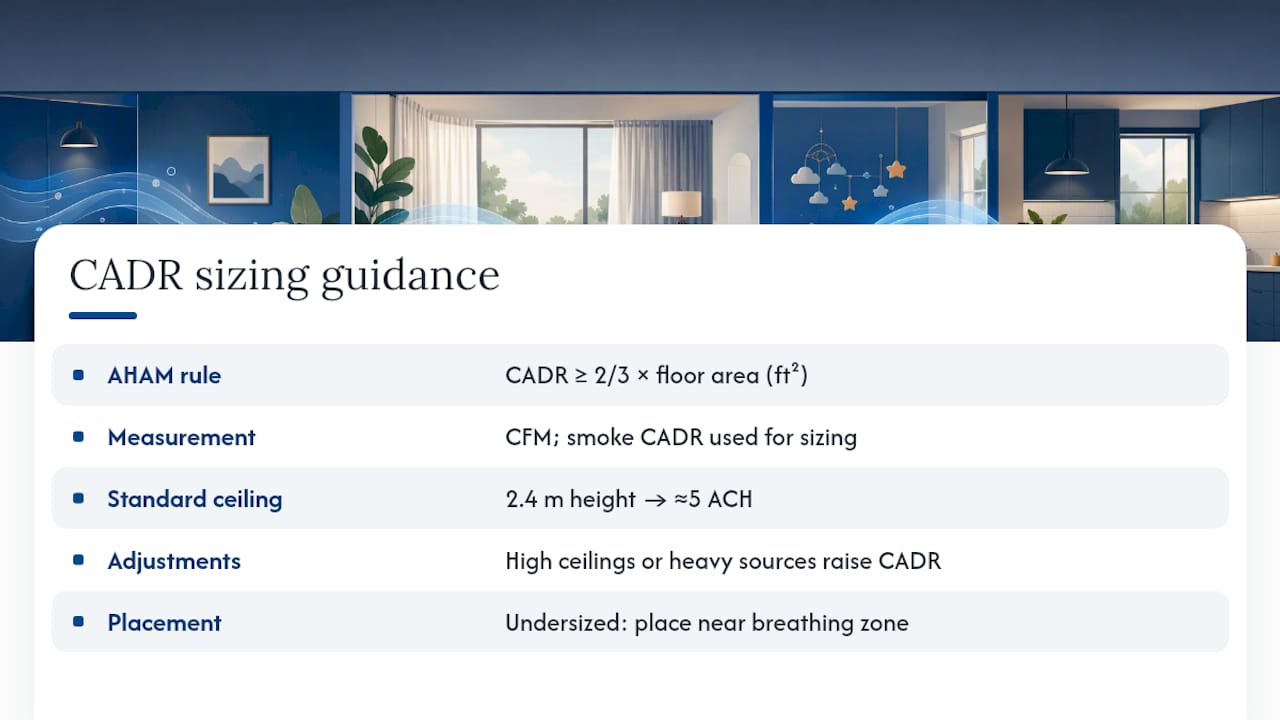
The AHAM ‘2/3’ rule states that a purifier’s smoke CADR should be at least two-thirds of the room’s floor area in square feet. For a room with a standard 2.4 m ceiling, this delivers roughly five air changes per hour, which is the accepted minimum for effective particle reduction.
Ceiling height changes the calculation. Open-plan spaces and heavy pollutant sources (a smoker, multiple pets, a wood-burning stove) push the requirement higher still.
A higher CADR also gives you more placement flexibility. A unit rated well above the room’s minimum can sit slightly further from the breathing zone and still deliver adequate air changes. An undersized unit, by contrast, needs to be placed as close to the breathing zone as possible to compensate for its limited reach. For a deeper look at matching CADR to room type, the best air purifiers for UK facilities guide covers capacity selection in more detail.
IQAir, whose units carry some of the highest CADR ratings available for residential use, recommends sizing up rather than down when in doubt, particularly for allergy sufferers or anyone with respiratory conditions.
Hands-on setup checklist: confirming good placement
Follow this sequence when installing or moving a unit:
- Measure the room and confirm the purifier’s CADR meets the AHAM 2/3 minimum for that floor area.
- Clear 20–30 cm of space on all sides, including the rear and top if the unit has a top outlet.
- Elevate if needed. For bedrooms, place on a bedside table or low shelf at mattress height. For living rooms, a side table at seated head height works well.
- Orient the output toward the breathing zone, not toward a wall or corner.
- Run on high for 30–60 minutes with the door and windows closed before you use the room.
- Check the air quality indicator (if fitted) or use a separate monitor. A reading that drops noticeably within 20–30 minutes confirms the placement is working.
- Route the cable safely. Avoid trailing leads across doorways or under rugs.
- Check filter-change access. You should be able to open the filter panel without shifting the unit.
Pro Tip: The high-then-low bedroom routine: run the purifier on its highest setting with the door closed for 30–60 minutes before you go to bed, then switch to night or quiet mode. You get a deep clean of the room’s air before sleep, then near-silent maintenance through the night.
Diagnosing weak performance and keeping filters fresh
If your purifier does not seem to be improving air quality, work through this checklist before assuming the unit is faulty:
- Blocked intakes. Check for dust build-up on the pre-filter grille. A clogged pre-filter can cut airflow substantially even when the HEPA layer is still serviceable.
- Fan speed too low. Many units default to auto or low after a power cycle. Check the setting.
- Wrong-sized unit. If the CADR is below the AHAM 2/3 minimum for the room, no placement will fully compensate.
- Doors or windows open. Continuous outdoor air ingress is the most common reason a room fails to improve despite the purifier running.
- Dirty filters. HEPA filters in typical UK homes generally need replacing every 6–12 months depending on use and air quality. Pre-filters benefit from a vacuum or rinse every 2–4 weeks. Replacement HEPA filters, such as the Biodrier Executive replacement HEPA filter, are available for specific models.
Placement problem vs filter problem: if the air quality improves noticeably within 1 metre of the unit but not across the room, the unit is working but is either undersized or poorly positioned. If air quality does not improve even close to the unit, the filter or fan is the issue.
Noise that increases over time usually signals a clogged pre-filter increasing motor load. Clean the pre-filter first before assuming a mechanical fault. If noise is the reason you are running the unit on low all the time, move it further from the bed and run it on high, rather than keeping it close and quiet.
How your primary pollutant changes the best spot
Not all airborne particles behave the same way, and the optimal air purifier setup shifts depending on what you are trying to remove.
Heavier particles (large pet hair, settled dust, tracked-in soil) sink quickly and accumulate near the floor. Floor-level placement captures these before they resettle, though you still need the 20–30 cm wall clearance.
Fine particulates (pollen, PM2.5, fine pet dander, wildfire smoke) stay airborne much longer. Elevated placement at 60–90 cm captures these more effectively because the intake aligns with the zone where they circulate.
Odours and VOCs (cooking fumes, paint, cleaning products) require an activated-carbon filter layer in addition to HEPA. Placement near the source, such as the kitchen doorway for cooking odours, is more effective than central placement.
Practical examples:
- Pet dander in a living room: place the unit near the pet’s favourite spot at floor level for large hair, but elevate slightly if fine allergens are the concern.
- Wildfire smoke or urban PM2.5 entering through windows: position the unit away from the window, toward the centre of the room, so it processes air that has already entered rather than drawing in more outdoor air.
- Cooking particulates: place near the kitchen doorway to intercept particles as they spread, not beside the hob.
- Pollen season: move the unit near the main entry point (hallway or bedroom door) to catch pollen tracked in on clothing and hair.
Pro Tip: Rotate placement seasonally. During pollen season, move the bedroom unit near the door to intercept incoming allergens. In winter, when cooking and heating are the main sources, shift it toward the kitchen side of the living space. A unit on castors makes this trivially easy.
For broader guidance on improving indoor air quality at home, combining purifier placement with ventilation habits and source control gives better results than any single measure alone.
Why most people get bedroom placement wrong
The standard advice is to put the purifier “near the bed.” That is fine as far as it goes, but it misses the detail that actually matters: the unit needs to deliver clean air into the breathing zone without creating a draught, and it needs the room to be enclosed to work properly.
Most people place the unit on the floor in a corner because it is tidy and out of the way. That is precisely the worst position: corners trap air, floors collect debris that clogs pre-filters faster, and the breathing zone at mattress height is left largely unserved. Moving the unit to a bedside table or low shelf, 1.8–3 metres from the head of the bed, with the door closed, is a straightforward change that makes a genuine difference to the air you breathe overnight.
The other thing worth saying plainly: a HEPA filter is not a substitute for ventilation. UK homes, particularly newer builds with good insulation, can accumulate VOCs and CO₂ that a HEPA purifier does not address. A purifier handles particles and some odours. For damp rooms and bathrooms, mechanical extraction remains the primary tool. Use both, not one instead of the other.
Simcodirect stocks air treatment products with fast UK delivery
Simcodirect carries a range of air treatment and home comfort products, including air purification systems, with fast UK delivery and a 30-day returns policy. If you are buying a purifier after reading this guide, the three things worth confirming before checkout are: the smoke CADR relative to your room size (use the AHAM 2/3 table above), whether the unit uses a true HEPA filter, and whether replacement filters are readily available for that model.
Simcodirect also stocks heating products including electric panel radiators and oil-filled column radiators for rooms where you are balancing warmth and air quality together. Browse the full range at Simcodirect and use the product filters to narrow by CADR rating or room size.
Sources
- Where to Place an Air Purifier for Best Results — Room-by-Room UK Guide
- Where to Put an Air Purifier in a Bedroom – Blueair
- Where to place an air purifier | Unlock AmazingAir’s potential
- Can You Use an Air Purifier in a Closed Room? - Air Oasis