


Best air purifiers for UK commercial facilities: 2026 guide
For commercial premises in the UK, the best air purifiers are specification-led systems with H13 or H14 HEPA filtration, an activated carbon stage, and a verified CADR that delivers 4–6 air changes per hour for your room volume. Consumer units simply do not cut it: commercial-grade systems are engineered for continuous duty and the higher pollutant loads found in offices, retail units, and washrooms.
Your immediate next steps:
- Confirm HEPA grade (H13 or H14) on the manufacturer’s datasheet, not in marketing copy
- Check CADR at the noise level you will actually run the unit (sub-40 dBA for occupied spaces)
- Plan commissioning before installation, not after
Simcodirect supplies commercial air treatment products with UK delivery and spare-parts support. Request datasheets and commissioning guidance before raising a purchase order.
Table of Contents
- Which air treatment system suits your space?
- How do you size a purifier for a commercial space?
- What filter grades should you specify?
- Installation and site constraints to check before you buy
- Procurement checklist for air treatment systems
- Maintenance, filter intervals, and total cost of ownership
- UK compliance references every facilities manager needs
- Key takeaways
- A practical note on getting this right
- How Simcodirect can help with your air treatment specification
- Useful sources
Which air treatment system suits your space?
Not every space needs the same solution. Match the product class to the operational reality.
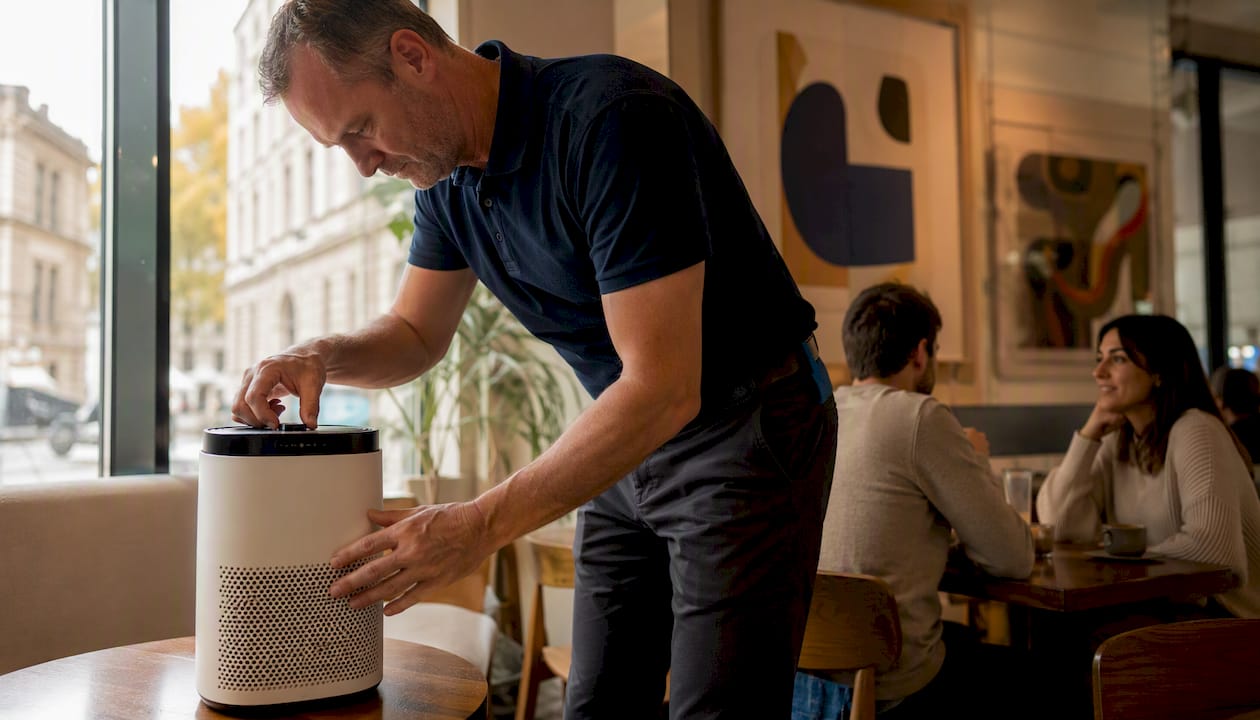
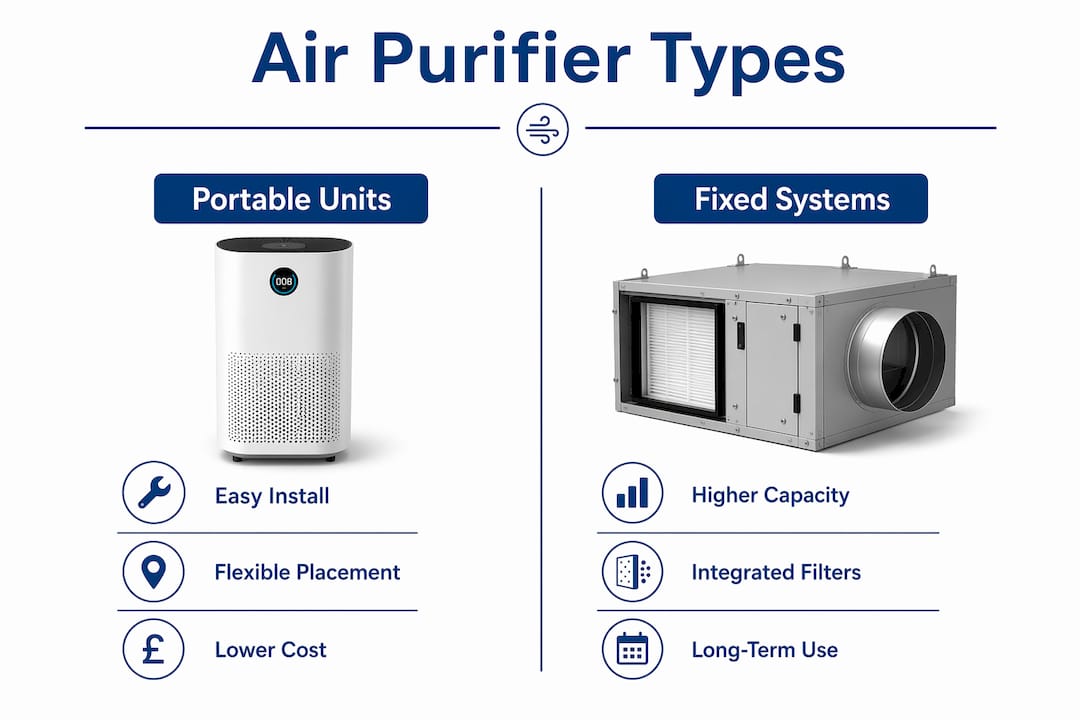
- Portable floor units suit open-plan offices, temporary or leased spaces, and situations where ducting is impractical. They require adequate clearance (typically 10–38 cm from walls and obstructions) to deliver the declared CADR.
- Wall-mounted units work well in washrooms, corridors, and smaller rooms where floor space is limited and a fixed installation is acceptable.
- In-duct or HVAC-integrated systems are the right choice for large open areas, high-ceiling atria, and buildings with existing mechanical ventilation. They treat air at source and distribute it through the existing ductwork.
- Dedicated washroom extract-plus-purification units combine extract ventilation with filtration, addressing both moisture and particulate loads in a single product. See Simcodirect’s washroom upgrade priorities for context on where air treatment fits within a broader washroom specification.
For use-case mapping: open-plan offices and retail benefit from portable or wall-mounted units at multiple points; healthcare-adjacent spaces and high-footfall areas need in-duct integration or high-CADR floor units running continuously; washrooms need dedicated extract-plus-filter combinations.
Pro Tip: Always pair a mechanical HEPA stage (H13 or H14) with an activated carbon stage. HEPA captures particulates; carbon handles VOCs and odours. Avoid ionisers unless explicitly required by the application — they can produce ozone, a recognised lung irritant.
How do you size a purifier for a commercial space?
Sizing starts with room volume and your target air changes per hour (ACH). The formula is straightforward:
- Measure the room: length × width × ceiling height = volume in m³
- Multiply by your target ACH (use 4–6 for high-traffic or high-ceiling areas)
- Convert to CADR: volume (m³) × ACH ÷ 60 = minimum CADR in m³/min
Worked example — open-plan office:
Room: 15 m × 10 m × 3 m = 450 m³. Target: multiple air changes per hour. Required CADR = 450 × 5 ÷ 60 = 37.5 m³/min (or approximately 625 l/s).
| Room type | Approx. volume (m³) | Target ACH | Min. CADR (m³/min) |
|---|---|---|---|
| Small office (4–6 desks) | 60 | 4 | 4–6 |
| Medium open-plan | — | 5 | — |
| Large open-plan | 450 | 5 | 37.5 |
| Commercial washroom | — | 6 | — |
| High-ceiling atrium | 1,— | 4 | — |
Add a 20% safety margin to your calculated figure to account for furniture, partitions, and placement constraints that reduce effective airflow.
Pro Tip: Approved Document F (Volume 2) specifies a supply rate of a specified supply rate per person for offices. Cross-check your ACH-based CADR against this per-person rate — whichever is higher governs your specification, according to Approved Document F guidance.
What filter grades should you specify?
H13 and H14 are the only HEPA grades worth specifying for commercial use. Both are defined under EN 1822; H13 captures at least 99.95% of particles at the most penetrating particle size, and H14 reaches 99.995%. Everything else is marketing.
Must-specify list:
- HEPA grade H13 or H14 (stated as an H-number on the datasheet, not as “True HEPA” or “Medical HEPA”)
- Activated carbon stage with stated carbon weight or bed depth for VOC and odour control
- Particulate capture to 0.1 microns where healthcare-adjacent or high-sensitivity environments are involved
- CADR quoted at a specified noise level (sub-40 dBA for occupied spaces)
Watch for these red flags on datasheets:
- “True HEPA” or “Medical HEPA” with no H-number: these terms are unregulated marketing with no standardised meaning
- CADR quoted at maximum fan speed with noise quoted at minimum speed — a common mismatch that makes units appear both powerful and quiet
- Ioniser or UV stages with no ozone output data; some UV configurations can generate ozone, which carries health risks in occupied spaces
- Missing filter part numbers or no UK supplier for replacements
Specification note: demand the EN 1822 H-number, the AHAM CADR figure at your target noise level, and the filter part number for replacements. If a supplier cannot provide all three, the product is not procurement-ready.
Installation and site constraints to check before you buy
Placement and integration decisions made at specification stage directly affect the CADR you actually get on site.
Pro Tip: Portable units placed flush against a wall can lose a significant portion of their declared CADR. Check the manufacturer’s minimum clearance requirement before finalising placement — it is usually buried in the installation manual, not the sales brochure.
Key site checks:
- Power supply: confirm socket availability and circuit load before specifying high-CADR units; larger in-duct systems may require a dedicated circuit
- Acoustic limits: in occupied offices and healthcare spaces, target sub-40 dBA at working speed; verify this against the datasheet, not the lowest-speed noise figure
- Ceiling height and obstructions: partitions, shelving, and high ceilings all reduce effective air distribution; a single high-CADR unit in one corner of a large open-plan rarely delivers uniform ACH
- HVAC interaction: in-duct systems must be balanced against existing supply and extract rates; adding filtration resistance without rebalancing the system reduces overall airflow
Commissioning is not optional. Approved Document F requires evidence that installed systems deliver the specified performance, and that evidence must be retained for the building record.
Procurement checklist for air treatment systems
Use this as a starting point for tender documents or supplier evaluation.
| Checklist item | What to verify |
|---|---|
| CADR at working noise level | Stated m³/min at sub-40 dBA |
| HEPA grade | H13 or H14 with EN 1822 reference |
| Carbon stage | Carbon weight or bed depth stated |
| Noise at working speed | Sub-40 dBA confirmed on datasheet |
| Power requirements | Voltage, current draw, circuit type |
| Commissioning plan | Airflow verification method stated |
| Filter part numbers | UK supplier confirmed |
| Warranty and service | UK service network named |
Questions to put to suppliers:
- Can you provide CADR at 38–40 dBA, not at maximum speed?
- What is the filter replacement interval at continuous operation?
- Where are spare parts held in the UK, and what is the lead time?
- Do you provide a commissioning certificate and airflow test report?
Contract red flags:
- Vague HEPA claims with no H-number
- No commissioning requirement in the supply contract
- Spare parts available only from overseas
- Warranty that excludes filter media or fan motors
Budgeting for lifecycle costs — filters, energy, and planned servicing — is as important as the purchase price. A unit with cheap filters and low energy draw at working speed often costs less over three years than a cheaper unit with expensive consumables.
Maintenance, filter intervals, and total cost of ownership
Filter replacement is the single largest recurring cost. Plan for it at procurement, not when the filter warning light comes on.
- Pre-filters: inspect every 4–8 weeks in high-dust environments; replace or wash per manufacturer guidance
- HEPA filters (H13/H14): typical replacement interval ranges vary depending on operational conditions; shorter in high-particulate environments
- Activated carbon stages: replace periodically in spaces with VOC or odour loads; carbon saturates without visible indication
Total cost of ownership checklist:
- Filter replacement cost per year (pre-filter, HEPA, carbon)
- Energy consumption at working speed (kWh per year)
- Planned servicing: fan motor inspection, housing clean, sensor calibration
- Disposal cost for spent HEPA filters (some grades require controlled disposal)
- Replacement fan or motor cost over a 5-year horizon
Logbook fields to maintain:
- Installation date and commissioning certificate reference
- Filter part numbers (pre-filter, HEPA, carbon)
- Filter change dates and condition notes
- Airflow test results at commissioning and each annual service
- Any faults, repairs, or parts replaced
Pro Tip: Keep filter part numbers and the UK supplier’s contact details in the logbook. A unit that cannot be serviced because replacement filters are out of stock is a compliance liability, not an asset. Simcodirect stocks replacement HEPA filters for commercial washroom equipment with fast UK delivery.
UK compliance references every facilities manager needs
Air treatment in commercial premises is not discretionary. Three documents define your legal and best-practice obligations.
- Workplace Health, Safety and Welfare Regulations 1992, Regulation 6: employers must provide sufficient fresh or purified air in every enclosed workplace. This is the primary legal duty. Air purification systems count as “purified air” only when they demonstrably deliver the required air quality.
- Approved Document F, Volume 2: technical guidance for non-domestic buildings covering supply rates (10 l/s per person for offices), extract strategies, and commissioning requirements. Cite this in tender specifications.
- BESA TR19 Air Specification, Version 2 (March 2026): the current industry benchmark for ventilation system cleanliness and hygiene management. Aligning with TR19 v2 requires documented inspection, cleaning records, and filter-change traceability. Include it in tender documents where hygiene is a procurement objective.
“Regulation 6 requires employers to ensure every enclosed workplace is ventilated by a sufficient quantity of fresh or purified air. HSE guidance confirms that mechanical purification systems can satisfy this duty, provided they are correctly specified, commissioned, and maintained.”
Certifications and test marks to demand:
- EN 1822 H-number for HEPA grade
- AHAM CADR certification (or equivalent tested airflow evidence)
- CE or UKCA marking on the unit
- Commissioning certificate retained in the building record
For washroom-specific ventilation compliance, Regulation 6 and Approved Document F both apply; extract rates and purification must be specified together.
Key takeaways
Commercial air treatment in the UK requires a specification-led approach: H13 or H14 HEPA filtration, a verified CADR at sub-40 dBA, and commissioning evidence retained for compliance.
| Point | Details |
|---|---|
| Specify H13 or H14 by H-number | Reject any HEPA claim without an EN 1822 H-number on the datasheet. |
| Size by CADR and ACH | Target 4–6 ACH; add a safety margin to your calculated CADR figure. |
| Budget for whole-life cost | Include filters, energy, and servicing — not just purchase price. |
| Commission and document | Retain airflow test results and filter-change logs for Regulation 6 compliance. |
| Simcodirect for UK supply | Simcodirect supplies commercial air treatment products with UK delivery, spare parts, and datasheet support. |
A practical note on getting this right
The compliance framework here is clear enough. What trips up most procurement decisions is not ignorance of the regulations but the gap between what a datasheet claims and what a unit actually delivers on site. CADR figures quoted at maximum speed, HEPA claims without an H-number, and commissioning skipped to save a day’s cost — these are the failure modes that generate HSE notices and unhappy tenants.
The advice in this guide is general information. For your specific building, confirm current requirements with HSE guidance, Approved Document F, and a qualified ventilation engineer.
How Simcodirect can help with your air treatment specification
Simcodirect is a UK-based online retailer stocking commercial washroom and air treatment equipment, with fast delivery and a 30-day returns policy. For facilities managers and contractors who need procurement-ready products backed by datasheets and UK spare-parts availability, Simcodirect offers a practical alternative to long-lead specialist suppliers.
The product range covers commercial hand dryers, washroom accessories, and air treatment equipment, all available for one-time purchase with bulk pricing for larger orders. The Vent-Axia PrepDry automatic hand dryer is one example of the commercial-grade washroom equipment available for immediate dispatch.
To request product datasheets, check stock availability, or discuss commissioning support for your site, visit simcodirect.co.uk or contact the team directly. UK service and spare-parts support are available across the range.
Useful sources
- Workplace Health, Safety and Welfare Regulations 1992, Regulation 6 — the primary legal duty for ventilation in enclosed workplaces; cite in tender specifications as the compliance baseline.
- Approved Document F, Volume 2 (non-domestic buildings) — design rates, extract strategies, and commissioning requirements; use when setting CADR and ACH targets in specifications.
- HSE: Ventilation at work — practical employer guidance on satisfying Regulation 6; useful for handover documentation and compliance evidence.
- BESA TR19 Air Specification, Version 2 (March 2026) — industry benchmark for ventilation hygiene and cleanliness management; include in tender documents where hygiene is a procurement objective.
Practical advice on document use:
- Cite Regulation 6 and Approved Document F in every tender specification for non-domestic air treatment
- Reference BESA TR19 v2 where duct hygiene and filter-change traceability are procurement requirements
- Retain commissioning certificates, airflow test results, and filter-change logs as evidence of ongoing compliance
- Save filter part numbers and UK supplier contacts in the building maintenance record from day one