


Commercial washroom accessory grades: UK guide for 2026
Commercial washroom accessory grades in the UK primarily refer to stainless steel classifications, with Grade 304 (EN 1.4301) and Grade 316 (EN 1.4401) covering the vast majority of commercial bathroom fittings. The grade you specify determines corrosion resistance, lifespan, maintenance burden, and ultimately whether your installation holds up under the conditions your facility actually faces. Two British Standards govern how accessories should be selected, installed, and maintained: BS 6465-3:2020, which covers selection and maintenance of sanitary appliances, and BS 6465-1:2006, which sets out design and accessibility requirements. The UK Health and Safety Executive (HSE) adds a further layer, mandating minimum fixture counts based on the number of people using the facility.
Key grades and standards at a glance:
- Grade 304 (EN 1.4301): Standard commercial grade, suitable for most interior washrooms with moderate humidity and soft to moderately hard water.
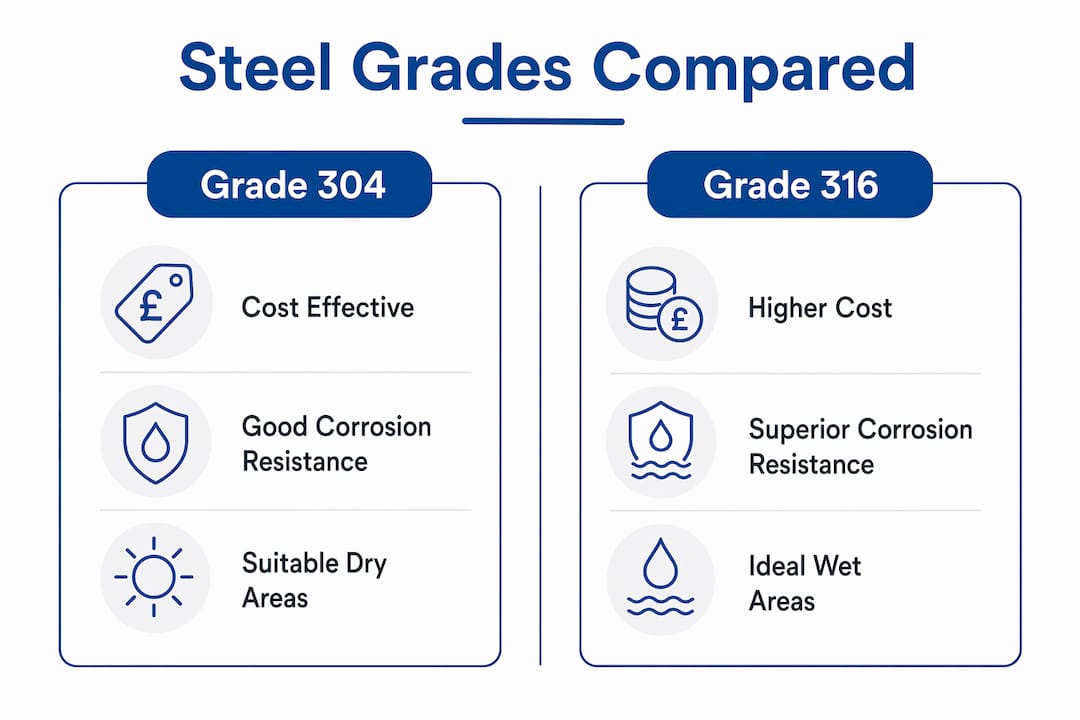
- Grade 316 (EN 1.4401): Higher corrosion resistance due to 2–3% molybdenum content; specified for coastal sites, swimming pools, and areas using chloride-based cleaning agents.
- BS 6465-3:2020: UK code of practice for selecting, installing, and maintaining sanitary appliances.
- BS 6465-1:2006: Design and accessibility framework for sanitary installations in new and refurbished buildings.
- HSE workplace regulations: Legally binding minimum provision for toilets and washbasins based on staff numbers.
Table of Contents
- How do grades 304 and 316 stainless steel actually differ?
- What do British Standards and HSE regulations require?
- How should you choose the right commercial washroom accessories?
- What do common commercial washroom terms actually mean?
- Expert advice on maintaining commercial washroom accessories
- Key takeaways
- Simcodirect: commercial washroom accessories built for compliance
How do grades 304 and 316 stainless steel actually differ?
The chemical gap between these two grades is smaller than most people expect, but the practical consequences are significant. Grade 304 contains 18–20% chromium and 8–10.2% nickel, with no molybdenum. Grade 316 carries 16–18% chromium, 10–14% nickel, and crucially, 2–3% molybdenum. That molybdenum addition raises the Pitting Resistance Equivalent Number (PREN) from roughly 18–20 for 304 to approximately 24–26 for 316, quantifying the difference in resistance to chloride-induced pitting corrosion. In a washroom context, chlorides arrive from cleaning agents, hard water, and in coastal buildings, airborne salt.
Tensile and yield strengths are essentially identical between the two grades, so the choice is purely about corrosion performance and cost. Grade 316 generally costs more than 304 at the material level due to its enhanced corrosion resistance. For finished accessories, the premium is proportionally smaller once fabrication and finishing costs are factored in, but it remains a real budget consideration across a full washroom fit-out.
Lifecycle expectations reflect the chemistry. In standard interior commercial washrooms, Grade 304 performs reliably with correct maintenance. Grade 316 is appropriate where water conditions and environment involve elevated dissolved solids, chloramine disinfection, or coastal airborne chloride exposure. For stainless steel washroom fittings in healthcare, hospitality, or leisure settings with aggressive cleaning protocols, 316 is the safer long-term choice.
Grade comparison summary:
- Chromium content: 304 around 18–20%; 316 around 16–18%.
- Molybdenum: None in 304; present in 316.
- PREN: Lower in 304; higher in 316, indicating better pitting resistance.
- Price premium: 316 is more expensive than 304 at material level.
- Best environments for 304: Low-humidity interior washrooms, soft to moderately hard water, standard municipal chlorination.
- Best environments for 316: Coastal locations, swimming pools, spas, healthcare facilities, areas using bleach-based sanitisers regularly.
Pro Tip: When specifying a large commercial fit-out, consider a hybrid approach: specify 316 for wet zones such as basin surrounds, shower areas, and grab rails near water, and 304 for dry zones including cubicle hardware and door furniture. This approach, endorsed by washroom planning practitioners, balances lifecycle value without over-specifying across the entire installation.
What do British Standards and HSE regulations require?
BS 6465-3:2020 is the primary UK code of practice for the selection, installation, and maintenance of sanitary and associated appliances. It covers hand dryers, wash-basins, flushing cisterns, and hand-rinse basins, and includes guidance on maintenance schedules to support hygiene compliance. BS 6465-1:2006 sits alongside it, providing the overarching design framework and recommended scales of provision for different building types, from workplaces and schools to hotels and licensed premises. Together, these two standards form the backbone of compliant washroom specification in the UK.
The HSE’s workplace facilities guidance operates differently: it is legally binding rather than advisory. Employers must provide a minimum number of toilets and washbasins based on the number of people at work. The HSE minimum provision for mixed-use or women-only facilities is guided by the following structure: for 1–5 people, provide 1 toilet and 1 washbasin; for 6–25 people, provide 2 of each; for 26–50, 3; for 51–75, 4; and for 76–100, 5. This structured scale applies as per UK HSE and BS 6465-3:2020 compliance guidance.
Beyond fixture counts, the HSE requires facilities to be well lit and ventilated, with hot and cold running water, adequate soap, and a means of drying hands. Walls and floors should be tiled or covered in a waterproof material to support cleaning. These requirements directly influence accessory selection: a hand dryer, for instance, is not optional where paper towels are impractical, and the grade of the unit matters for longevity in a high-use environment.
For healthcare settings, compliance extends further. HTM 63, HTM 64, and HBN00-10 Part C govern validated stainless steel grades in NHS and private healthcare facilities. A generic “commercial grade” label on a product does not automatically satisfy these requirements without documented verification of the material specification.
Key compliance points for facility planners:
- Align accessory specifications with BS 6465-3:2020 and BS 6465-1:2006 from the design phase.
- Confirm HSE minimum fixture counts are met before finalising layouts.
- For healthcare environments, verify products meet HTM 63/64 and HBN00-10 Part C requirements.
- Ensure washroom ventilation meets building regulations alongside accessory compliance. Simcodirect’s washroom ventilation guidance covers the regulatory requirements in detail.
- Mismatched specifications identified after installation typically require costly retrofits rather than simple swaps.
How should you choose the right commercial washroom accessories?
The starting point is always the environment, not the budget. A washroom in a dry, well-ventilated office building in an inland city has fundamentally different demands from a changing room at a coastal leisure centre. Getting this assessment right at the outset is what separates a specification that holds up for fifteen years from one that needs replacing in five.

Three factors drive the decision: environment, traffic volume, and lifecycle cost. On environment, the key variables are humidity levels, water hardness, the cleaning chemicals your maintenance team uses, and whether the building is coastal. High-traffic facilities such as transport hubs, sports centres, and large office buildings also place greater mechanical stress on accessories, making material quality and fixing quality equally important. A commercial washroom remodelling guide for offices covers these decision points in the context of UK codes of practice.
Lifecycle cost is where many procurement decisions go wrong. Grade 304 accessories cost less upfront, but in a harsh environment they will corrode, stain, and require replacement sooner. Grade 316 carries a higher initial cost but delivers a lower total cost of ownership in demanding conditions. The ergonomic washroom design considerations that affect early specification also feed into this calculation: getting the right product in the right location from day one avoids the disruption and expense of remedial work.
Key selection criteria:
- Environment: Assess humidity, water hardness (TDS), proximity to coast, and cleaning chemical types before specifying grade.
- Traffic volume: Higher footfall demands more durable fixings and finishes, not just higher-grade steel.
- Budget allocation: Use Grade 316 where conditions justify it; Grade 304 in dry, low-risk zones to manage cost without compromising performance.
- Maintenance access: Specify accessories that your maintenance team can clean correctly. Inaccessible fixings or complex finishes increase the risk of chemical damage.
- Compliance documentation: Request material test certificates (MTCs) and grade markings from suppliers to verify specifications match what is installed.
What do common commercial washroom terms actually mean?
Product specifications and installation documents use a range of abbreviations and designations that are not always self-explanatory. Understanding them helps you verify that what a supplier quotes matches what the standard requires.
Material grade designations for stainless steel appear in three parallel systems. AISI 304 and AISI 316 are the American Iron and Steel Institute designations widely used in product catalogues. The European equivalents are EN 1.4301 (304) and EN 1.4401 (316), which appear in British and European specifications. JIS designations SUS304 and SUS316 originate from Japanese standards and appear on products manufactured in Asia. All three systems refer to the same alloys; the designation simply reflects the standard under which the material was classified.
Informal terms such as “marine grade” and “food grade” are descriptors, not standards. “Marine grade” is commonly used to mean Grade 316, but it has no formal definition and does not substitute for stating EN 1.4401 or AISI 316 in a specification document. Relying on informal terms leaves room for misinterpretation between specifier and supplier.
Common terms and abbreviations:
- W.C.: Water closet, meaning a toilet pan and cistern assembly.
- SGL: Solid grade laminate, a fully water-impervious panel material used for cubicle partitions and doors.
- EN 1.4301 / AISI 304 / SUS304: Three designations for the same standard commercial stainless steel grade.
- EN 1.4401 / AISI 316 / SUS316: Three designations for the higher-grade molybdenum-bearing stainless steel.
- PREN: Pitting Resistance Equivalent Number, calculated as Cr% + 3.3 × Mo% + 16 × N%; a quantified measure of chloride corrosion resistance.
- HTM: Health Technical Memorandum, NHS guidance documents governing materials and design in healthcare washrooms.
- HBN: Health Building Note, NHS guidance covering spatial and functional requirements for healthcare facilities.
- BS 6465: The British Standard series covering sanitary installations, with Part 1 covering design and Part 3 covering selection, installation, and maintenance.
Expert advice on maintaining commercial washroom accessories
Specifying the correct grade is necessary but not sufficient. The single most common cause of premature stainless steel failure in commercial washrooms is not poor material selection; it is incorrect cleaning. Bleach-based sanitisers left in contact with stainless steel surfaces for extended periods, or applied in concentrations above the manufacturer’s recommendation, can initiate pitting even on Grade 316 surfaces. The molybdenum in 316 raises the electrochemical threshold at which pitting begins, but it does not make the material immune.
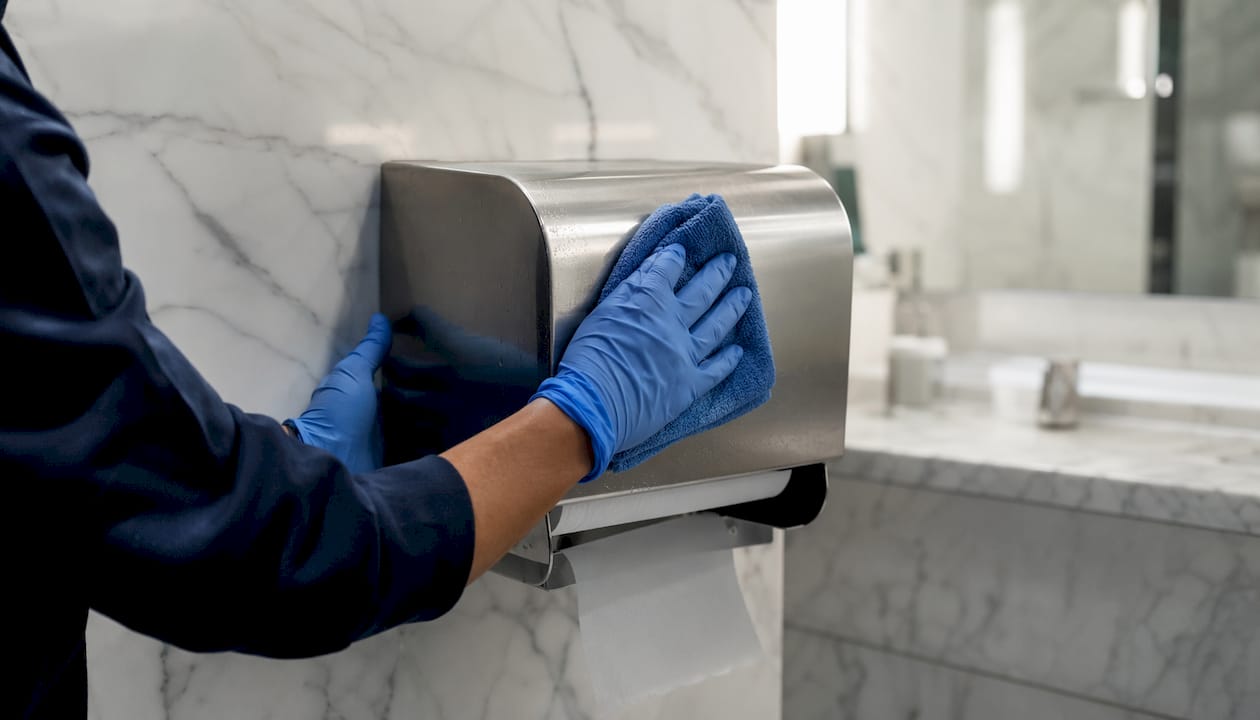
Correct cleaning protocol for stainless steel washroom accessories means using pH-neutral or mildly alkaline detergents, rinsing thoroughly after any chemical application, and wiping dry rather than leaving surfaces wet. Abrasive pads scratch the passive chromium oxide layer that gives stainless steel its corrosion resistance, so they should never be used. For high-traffic facilities, a documented cleaning schedule aligned with the maintenance guidance in BS 6465-3:2020 protects both the accessories and the facility’s compliance record.
Early specification alignment pays dividends throughout the lifecycle. Defective or mismatched accessory grades identified after installation typically require full replacement rather than repair, and the associated disruption to a working facility adds cost well beyond the price of the accessories themselves. Aligning specifications with BS 6465 and applicable HTM standards during the design phase, rather than treating accessories as a late-stage procurement decision, is the approach that consistently delivers better outcomes.
Pro Tip: When writing a specification for a mixed-use commercial facility, use PREN as the objective criterion rather than grade names alone. Specify a minimum PREN of 24 for wet zones and 18 for dry zones. This gives suppliers a measurable target and prevents substitution of lower-grade materials under the cover of informal descriptors like “marine grade.”
Key takeaways
Selecting the correct commercial washroom accessory grade from the outset, aligned with BS 6465 standards and HSE requirements, is the most cost-effective way to avoid premature failure and non-compliance.
| Point | Details |
|---|---|
| Grade 304 vs Grade 316 | Grade 316 carries a 20–30% material price premium but is required for coastal, high-humidity, or chemically aggressive environments. |
| PREN as a specification tool | Specify a minimum PREN of 24 for wet zones and 18 for dry zones to prevent grade substitution by suppliers. |
| BS 6465 and HSE compliance | BS 6465-3:2020 governs selection and maintenance; HSE mandates minimum fixture counts: 1 toilet and 1 basin for 1–5 staff, 2 for 6–25, 3 for 26–50, 4 for 51–75, and 5 for 76–100. |
| Hybrid material strategy | Deploying Grade 316 in wet zones and Grade 304 in dry zones balances durability and cost without over-specifying across the whole installation. |
| Simcodirect for compliant accessories | Simcodirect supplies commercial-grade washroom accessories, including hand dryers and fittings, with fast UK delivery and a 30-day returns policy. |
Simcodirect: commercial washroom accessories built for compliance
Facility managers who have worked through the grade selection process know the frustration of finding the right specification and then struggling to source products that actually match it. Simcodirect stocks commercial-grade washroom accessories, including hand dryers with brushed satin finishes suited to high-traffic environments, with fast UK delivery and a 30-day returns policy that removes the procurement risk.
The UltraDry Pro 1 hand dryer in brushed satin is a practical example: a commercial-specification unit with a finish that holds up under the cleaning protocols your maintenance team already uses. For facilities where hygiene compliance is the priority, the Biodrier Executive hand dryer offers an effective alternative at a competitive price point. Both are available for immediate despatch, with full product documentation to support your specification records. Browse the full range at Simcodirect and match the right product to the grade and compliance requirements your facility demands.
Recommended
- Why stainless steel washroom fittings outperform all alternatives – Simco Direct
- Hand dryer guide for commercial washrooms: 2026 – Simco Direct
- Washroom Ventilation Requirements Explained for Compliance – Simco Direct
- The Essential Guide to Electric Hand Dryers for Commercial Washrooms – Simco Direct