


Home office air conditioner: quiet, efficient options
For most UK home offices, a quiet wall-mounted split system is the best long-term choice. For renters or anyone needing flexibility, a dual-hose portable unit is the practical alternative. Either way, get the sizing right first.
Quick size guide for the most common home-office rooms:
- Small office (6–10 m²): 2.0 kW / 7,000 BTU
- Typical home office (10–15 m²): 2.5 kW / 8,500 BTU
- Larger office (15–25 m²): 3.5 kW / 12,000 BTU
Before you buy anything, check three things: your room’s floor area, whether you rent (landlord permission is required for any permanent installation), and the unit’s noise spec. For video calls, you want an indoor noise rating under 25 dB(A). Many portable units run at 55–65 dB(A) at full speed, which is audible on any microphone.
Table of Contents
- Which type of air conditioner suits a home office?
- How to choose the right home office air conditioner
- How to size your unit correctly
- Noise, energy use and running costs
- Setting up and maintaining a portable unit
- Simcodirect’s home-office-friendly air conditioners
- Low-cost ways to stay cool while you wait for delivery
- Key takeaways
- What I have learned from watching people get this wrong
- Buy your home office AC from Simcodirect
- Useful sources and further reading
Which type of air conditioner suits a home office?
Three main types are worth considering. Each suits a different situation, and the trade-offs are real.
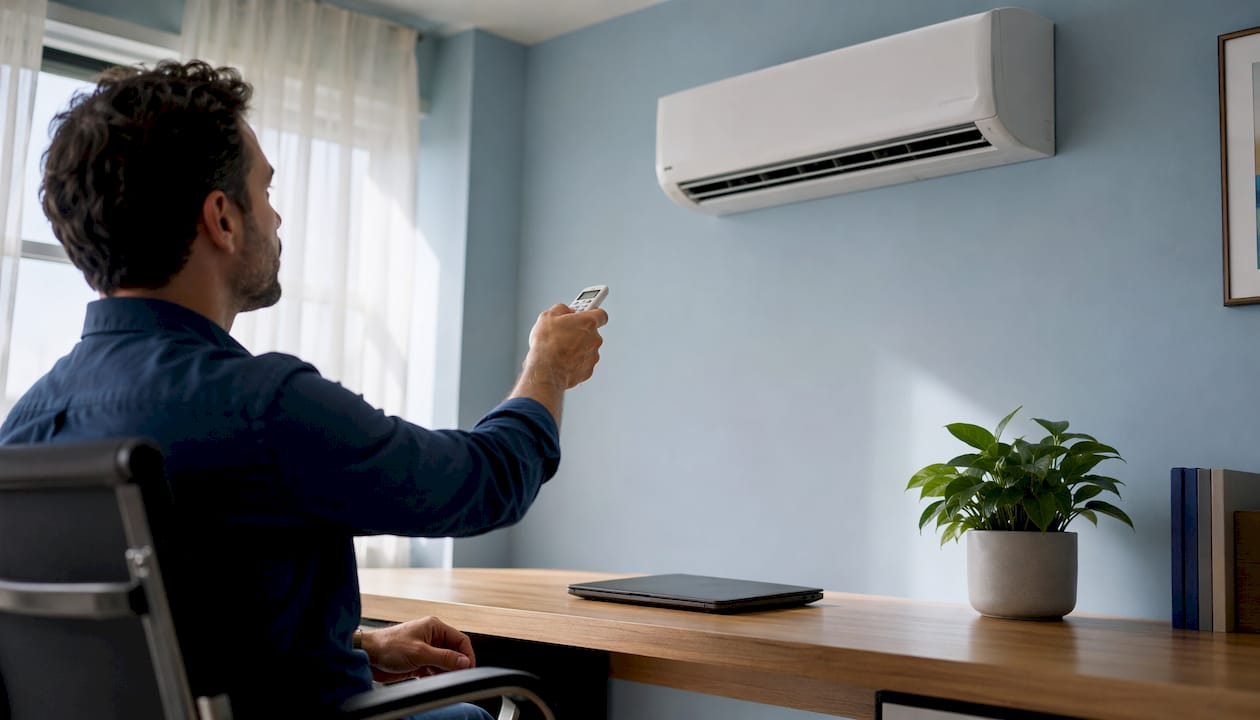
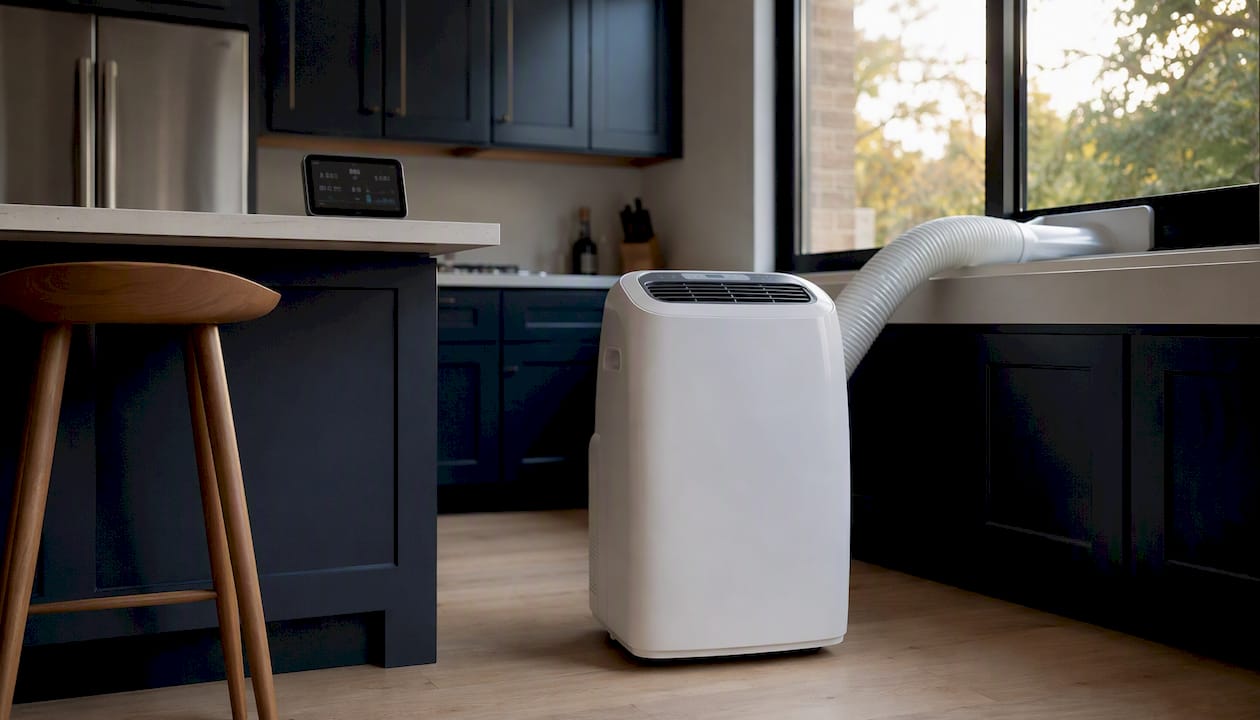
Portable units are the go-to for renters and anyone who wants to move the unit between rooms. They need no permanent installation, just a window or door gap for the exhaust hose. The downside is noise and efficiency. Single-hose portables create negative pressure inside the room, drawing warm air back in through gaps and losing roughly a third of effective cooling as a result. Dual-hose models avoid that problem by drawing intake air from outside rather than from the room itself.
Window units are less common in UK homes than in the US, and most UK sash or casement windows do not accommodate them without modification. They are worth considering only if you have a compatible window opening and landlord permission.
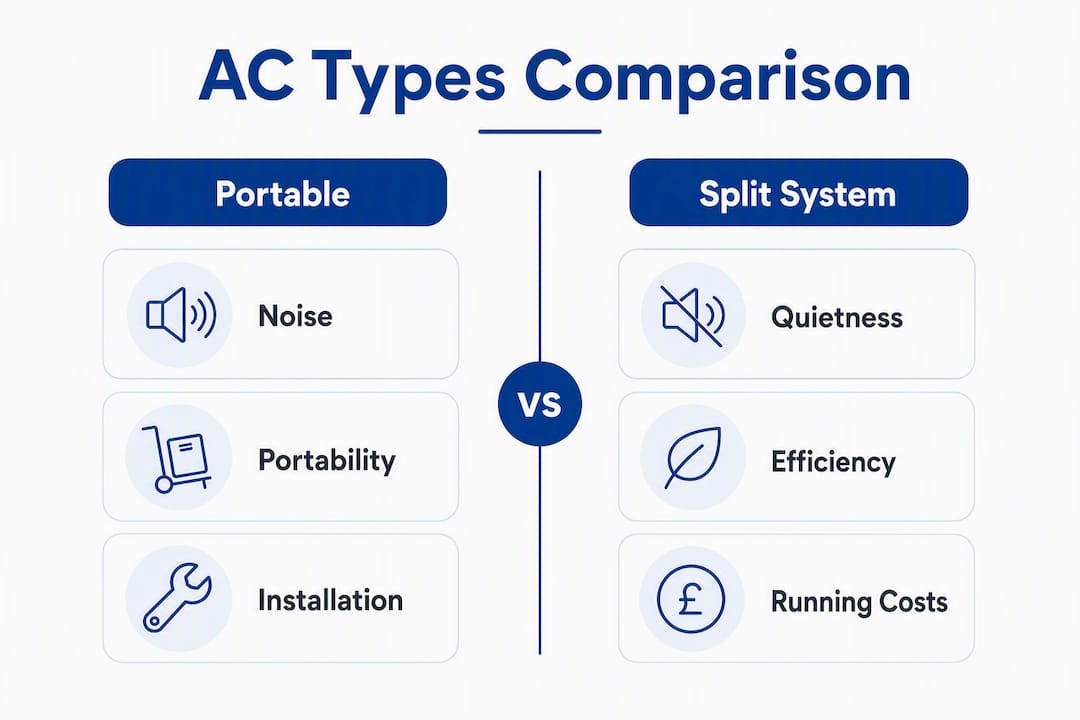
Split (mini-split) systems are wall-mounted, permanently installed, and quieter than any portable. Inverter-driven compressors mean they ramp up and down rather than cycling on and off, which keeps noise low and running costs down. The catch is installation: you need an F-Gas certified engineer, and if you rent, you need written permission before drilling through an external wall.
| Type | Noise | Efficiency | Installation | Portability | Typical price range |
|---|---|---|---|---|---|
| Portable (single-hose) | 50–65 dB | Low | None | High | — |
| Portable (dual-hose) | — | Medium | None | High | £350–£650 |
| Window unit | — | Medium | Minor | Low | £350–£650 |
| Split (mini-split) | 19–35 dB | High | Professional | None | £800–£1,800 |
Running costs follow the same pattern. A split system typically costs roughly half per hour compared with a portable of equivalent output, thanks to higher COP ratings and inverter technology. For daily home-office use across a full summer, that difference adds up.
How to choose the right home office air conditioner
A short checklist prevents the most common mistakes. Work through it before you look at any product page.
- Measure the room. Floor area in m² is your starting point. Note ceiling height too — rooms above 2.5 m need slightly more capacity.
- List your equipment heat sources. Monitors, docking stations, and printers all add to the cooling load. A room with two monitors and a laser printer needs meaningfully more capacity than a bare desk.
- Check glazing and orientation. South or west-facing windows with no external shading can add significantly to solar gain, particularly in the afternoon.
- Set your noise tolerance. If you take video calls, aim for a unit rated under 25 dB(A) on its quiet mode. Anything above 30 dB(A) will be audible to the person on the other end.
- Confirm landlord permission. For split systems, you need written consent before any drilling. For portables, check whether the window kit leaves a permanent mark.
Questions to ask on any product page:
- What is the noise level in dB(A) on the lowest fan speed, not just the headline figure?
- Is the BTU rating based on single-hose or dual-hose operation?
- Does the unit auto-evaporate condensate, or does it need a drain bucket?
- What is the energy rating, and what is the input kW (not just the cooling output)?
- What are the warranty terms and the returns window?
Red flags to watch for:
- No noise specification at all, or only a single high-speed figure
- Single-hose portable with no efficiency caveat
- BTU rating without a corresponding kW input figure
- Vague warranty language (“manufacturer’s warranty applies”) with no stated duration
- No UK delivery confirmation or unclear returns policy
How to size your unit correctly
The table below maps room size to the capacity you actually need in a home-office context. These figures are higher than bedroom baselines because equipment heat and long daily occupancy raise the effective load.
| Room size (m²) | Indicative BTU | Indicative kW | Typical use case |
|---|---|---|---|
| 6–10 | 7,000 | 2.0 | Small spare bedroom office |
| 10–15 | 8,500 | 2.5 | Standard home office |
| 15–25 | 12,000 | 3.5 | Large home office or garden office |
These figures come from standard UK sizing guidance of roughly 300–400 BTU per m², adjusted upward for office equipment. For a deeper explanation of BTU and kW conversion, the Simcodirect BTU guide is a useful reference.
Worked example: a 12 m² office with two monitors, a docking station, and a south-facing window.
- Base load: 12 m² × 350 BTU = 4,200 BTU
- Equipment uplift: two monitors plus docking station adds a meaningful heat load, pushing the effective requirement closer to 6,000–7,000 BTU
- Solar gain: south-facing glazing with no external shading adds further load, so round up to 7,000–8,000 BTU (approximately 2.0–2.5 kW)
- Conclusion: a 2.5 kW unit is the right choice here, not the smallest available 1.5 kW model
One practical warning: do not oversize aggressively. A unit that is too large cools the air quickly but does not run long enough to dehumidify it properly. The result is a room that feels cold and clammy rather than comfortable.
Noise, energy use and running costs
Running cost is straightforward to estimate. Multiply the unit’s input power in kW by the hours you run it, then by the current unit rate. At the Ofgem price cap rate of 24.67p/kWh, the per-hour costs for common portable sizes work out as follows:
- 7,000 BTU (≈0.75 kW input): roughly 19p per hour
- 9,000 BTU (≈1.0 kW input): roughly 24p per hour
- 12,000 BTU (≈1.3 kW input): roughly 32p per hour
- 14,000 BTU (≈1.6 kW input): roughly 39p per hour
Run a 9,000 BTU portable for six hours a day across a ten-week UK summer and you are looking at approximately £100 for the season. A split system of equivalent output costs roughly half that, because its COP is higher and it does not suffer the negative-pressure losses of a single-hose portable.
Noise thresholds that actually matter for office work:
Indoor units below 25 dB(A) are effectively inaudible on standard webcam microphones. Between 30–35 dB(A), the unit becomes noticeable on calls. Many portable units run at 55–65 dB(A) at full speed, which is clearly audible to anyone on a video call. The practical answer is to look for a unit with a dedicated quiet or sleep mode rated under 30 dB(A), and to pre-cool the room before calls start so the unit is running at low speed or has cycled off by the time you go live.
Statistic: Indoor units rated below 25 dB(A) are inaudible on standard laptop microphones; portable units at full speed commonly reach 55–65 dB(A), which is clearly audible on calls.
Single-hose versus dual-hose: the efficiency gap
A single-hose portable exhausts hot air outside but draws its intake air from the room itself. That creates negative pressure, and the room compensates by pulling warm air back in through door gaps, window frames, and any other opening. Dual-hose designs avoid this entirely by using a second hose to draw intake air from outside. The real-world difference is not marginal. For a home office where the unit runs for hours at a time, a dual-hose model delivers materially more of its rated cooling to the room and reaches the target temperature faster, which means it runs at high speed for less time.
Pro Tip: Pre-cool your office 20–30 minutes before your first call of the day. Set the unit to its maximum cooling mode while you make coffee, then drop it to quiet mode before you sit down. The room temperature holds for long enough that the unit barely needs to run during the call itself.
Setting up and maintaining a portable unit
Getting the installation right matters as much as choosing the right unit. A poorly sealed window kit can undo most of the efficiency gains from choosing a dual-hose model.
Setup steps:
- Position the unit within reach of a window, with the exhaust hose as short and straight as possible. A kinked or extended hose reduces airflow and forces the compressor to work harder.
- Fit the window kit and seal any gaps around it. Foam tape or draught-excluding strip works well. Even a 10 mm gap lets warm air back in continuously.
- Close the office door. Trying to cool an open-plan space with a portable unit rated for 12 m² will not work.
- Avoid placing the unit where it draws air that has already been warmed by equipment. Position it away from the back of monitors and server equipment where possible.
- Direct the airflow across the room rather than straight at your desk. Even cooling is more comfortable than a cold blast at close range.
Maintenance checklist:
- Clean or rinse the air filter every two to four weeks during heavy use. A clogged filter reduces airflow and forces the compressor to run longer.
- Check the condensate tank weekly if the unit does not auto-evaporate. A full tank triggers automatic shutdown on most models.
- At the end of the season, run the unit in fan-only mode for a few hours before storage to dry out internal components and prevent mould.
- Inspect the window kit seals each spring before first use. Foam tape degrades over winter.
Note on indoor air quality: Most portable units include a basic dust filter. If you have allergies or asthma, check whether the unit supports a HEPA or activated carbon filter upgrade. Running a unit with a dirty filter recirculates dust and allergens rather than removing them.
Split systems and F-Gas compliance:
If you are considering a split system, the refrigerant work must be carried out by an F-Gas certified engineer. This is a legal requirement in the UK, not a recommendation. Attempting to handle refrigerant without certification is an offence under the F-Gas Regulation. Budget for professional installation on top of the unit cost, and get written landlord permission before any work begins if you rent.
Simcodirect’s home-office-friendly air conditioners
Simcodirect stocks a range of air conditioning units suited to home-office use, selected on the basis of capacity range, energy efficiency, and suitability for small-to-medium rooms. The shortlist below covers the main categories available.
Selection criteria used:
- Capacity appropriate for 6–18 m² home offices (roughly 2.0–3.5 kW)
- Noise specification available and suitable for office use
- Dual-hose option or split-system option where possible
- UK delivery confirmed, 30-day returns policy, warranty stated on product page
Portable units (dual-hose preferred):
- Room suitability: 10–18 m²
- Capacity: 9,000–12,000 BTU (2.5–3.5 kW)
- Noise: check product page for quiet-mode dB rating; prioritise models with a sleep or quiet mode under 50 dB
- Features: look for auto-evaporation, timer, and remote control as standard
- Typical price: £350–£650
- Warranty: check individual product pages; Simcodirect lists warranty terms per model
Split (wall-mounted) units:
- Room suitability: 6–25 m²
- Capacity: 2.0–3.5 kW
- Noise: indoor units typically 19–35 dB(A) on quiet mode
- Features: inverter compressor, heat pump function (heating and cooling), Wi-Fi control on selected models, dehumidify mode
- Typical price: £800–£1,800 (unit only; installation extra)
- Warranty: stated per product on Simcodirect product pages
Pro Tip: Before ordering, cross-reference the noise dB figure on the product page against the thresholds above. If the page only lists a single noise figure without specifying the fan speed, contact Simcodirect’s customer service team to confirm the quiet-mode rating before purchase.
For a broader look at portable options and how to compare them, the Simcodirect portable air conditioner guide covers the key decision points in detail.
Low-cost ways to stay cool while you wait for delivery
A unit on order takes a few days to arrive. These measures reduce peak temperature meaningfully in the meantime, and some are worth keeping in place permanently to reduce how hard any AC unit has to work.
Passive measures that cost nothing:
- Close blinds or curtains on south and west-facing windows before 10:00 AM. Solar gain through glass is the single biggest driver of afternoon heat in a typical home office.
- Open windows on opposite sides of the building after 9:00 PM to flush out stored heat. Cross-ventilation at night can drop room temperature by several degrees before you start work.
- Place a desk fan to direct airflow across your body rather than trying to cool the whole room. Personal cooling is far more energy-efficient than whole-room temperature reduction.
- Hang a damp towel in front of an open window on very hot days. Evaporative cooling is modest but real in low-humidity conditions.
Equipment and behaviour changes:
- Switch off monitors you are not actively using. A typical 27-inch monitor produces 30–40 W of heat continuously.
- Use power-saving or eco display settings. Reducing screen brightness from 100% to 50% cuts display power consumption noticeably.
- Move heat-generating equipment, such as a laser printer or external hard drives, away from your immediate workspace or into an adjacent room when not in use.
- A fan costs under 2p per hour to run, making it the right first response to mild warmth before reaching for a powered cooling unit.
External shading is worth considering for any office with significant south or west-facing glazing. Outdoor awnings and blinds can cut solar gain substantially before it enters the room, reducing the load on any cooling unit you do install.
Pro Tip: Combine a desk fan with closed blinds and a cool drink. That combination keeps most people comfortable up to around 27°C without any powered cooling at all, which means the AC only needs to run on the genuinely hot days rather than throughout the summer.
Key takeaways
A quiet, correctly sized unit is the single most important purchase decision for a home-office air conditioner: get the kW right and the noise spec under 25 dB(A), and everything else follows.
| Point | Details |
|---|---|
| Sizing rule | Use 2.5 kW for a 10–15 m² office; add capacity for equipment heat and south-facing glazing. |
| Noise target | Aim for under 25 dB(A) on quiet mode; portable units at full speed reach 55–65 dB(A) and are audible on calls. |
| Hose count matters | Dual-hose portables avoid the negative-pressure loss that costs single-hose units a significant portion of effective cooling. |
| Running cost estimate | A 9,000 BTU portable costs about a couple of dozen pence per hour at the current rate; a split system costs substantially less to run for the same cooling output. |
| Simcodirect range | Simcodirect stocks portable and split-system units suited to 6–18 m² home offices, with UK delivery and a 30-day returns policy. |
What I have learned from watching people get this wrong
The most common mistake is buying on price and ignoring noise. Someone spends £300 on a portable unit, sets it up in a 12 m² office, and then discovers on the first video call that it sounds like a tumble dryer. The noise spec was there on the product page, but they did not look for it.
The second mistake is undersizing. A 7,000 BTU portable in a 15 m² room with two monitors and afternoon sun will run continuously at full speed and still not reach a comfortable temperature. It will also be loud the entire time, because it never gets to drop to a lower fan setting.
The third mistake, less obvious, is buying a single-hose portable without understanding the hose-count issue. The box says 12,000 BTU. The room never feels like 12,000 BTU. That gap is the negative-pressure effect pulling warm air back in through every gap in the room envelope. Dual-hose models cost a little more, but they actually deliver what the spec sheet promises.
For split systems, the calculus is different. They are quieter, cheaper to run, and genuinely comfortable for day-long use. The barrier is installation cost and landlord permission. If you own your home and plan to work from it for the foreseeable future, a split system is the better investment. If you rent or move regularly, a well-chosen dual-hose portable is the practical answer.
Simcodirect’s range covers both categories, with clear product specs and a returns policy that gives you a genuine safety net if the unit does not perform as expected in your specific room.
Buy your home office AC from Simcodirect
Simcodirect gives you a direct route to a correctly specified home-office cooling unit, without the guesswork of a general marketplace. The range covers portable dual-hose units and wall-mounted split systems suited to rooms from 6 m² to 25 m², all with UK delivery and a 30-day returns policy.
Every product page lists the key specs you need to check before buying: cooling capacity in kW and BTU, noise level in dB, energy rating, and warranty terms. If a spec is not immediately clear, the customer service team can confirm quiet-mode noise ratings and help you match a unit to your room size before you commit.
Delivery is fast across the UK. Returns are straightforward within 30 days. For split systems, Simcodirect can advise on installation requirements and F-Gas certification needs so you know exactly what to budget before the unit arrives.
Browse the Simcodirect air conditioning range to find a unit matched to your room size, noise tolerance, and budget. Check the spec, confirm delivery to your postcode, and order with confidence.
Useful sources and further reading
The figures and guidance in this article draw on the following UK-focused sources. Use them to verify exact specifications, check current price-cap figures, and confirm installation requirements before purchase.
- Portable air conditioner running costs and the hose trap (Selectra) — per-hour running costs at the current price-cap rate and single-hose efficiency loss data
- Air conditioning buying guide UK (Guides4Homeowners) — split versus portable trade-offs, installation notes, and renter guidance
- Is air conditioning worth it in the UK? (Uswitch) — cost-benefit overview and current price-cap context
For current Ofgem price-cap rates, check the Ofgem website directly, as the unit rate changes quarterly and affects running-cost calculations.