


Inverter air conditioner benefits: the UK homeowner's guide
Inverter air conditioners are worth buying for most UK homeowners. They typically use significantly less electricity than fixed-speed non-inverter units, and because a modern split system also functions as an efficient heat pump in winter, you get year-round value from a single installation. That dual-use case is what makes the numbers work.
The three most immediate benefits for homeowners are:
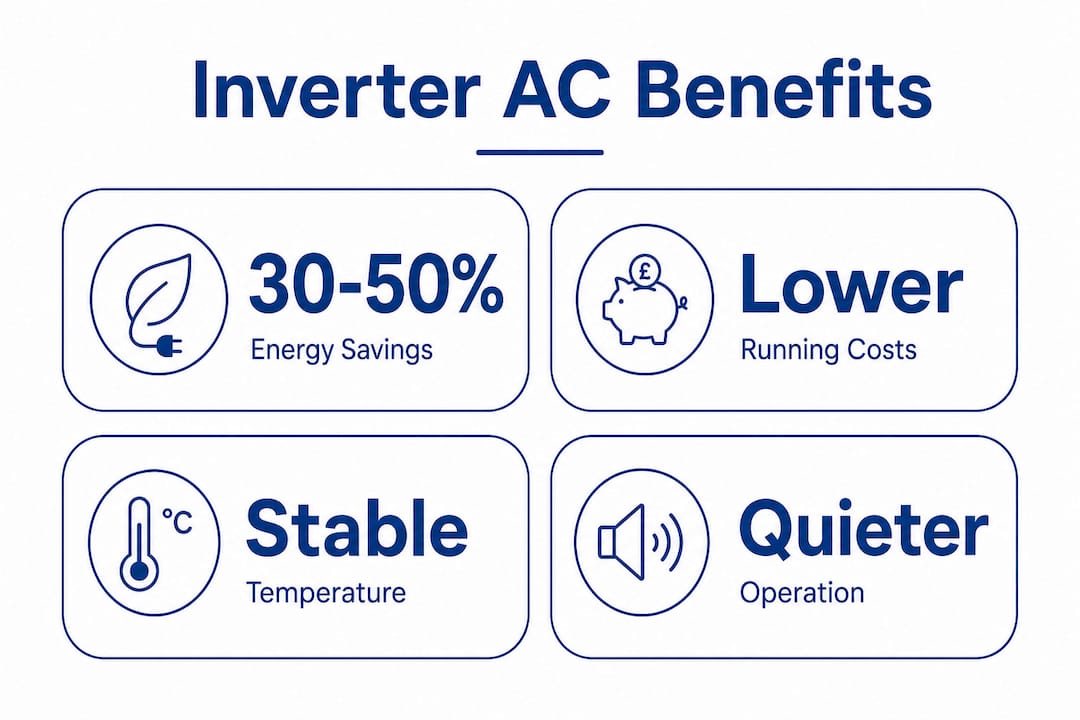
- Lower running costs — notably lower than a non-inverter unit, with a typical 2.5kW system costing roughly 10–30p per hour to run
- Quieter, steadier operation — continuous speed modulation means no noisy on/off cycling
- Heating as well as cooling — the same unit delivers efficient warmth in winter, shortening payback considerably
Inverter air conditioners can reduce energy consumption significantly compared with traditional fixed-speed models. (Becool Refrigeration)
Pro Tip: Always have your unit sized by an F-Gas registered engineer before purchase. An undersized inverter runs flat-out constantly, wiping out the efficiency gains entirely.
Table of Contents
- How does an inverter air conditioner actually work?
- What energy savings can you realistically expect in the UK?
- What comfort improvements do homeowners actually notice?
- What are the real costs and downsides to consider?
- How do you choose the right inverter air conditioner for your home?
- Key takeaways
- Why inverter technology is the right call for most UK homes
- Simcodirect can help you find the right heating and cooling solution
- Useful sources and further reading
How does an inverter air conditioner actually work?
The short answer: an inverter compressor varies its speed to match what the room needs, rather than switching fully on or fully off.
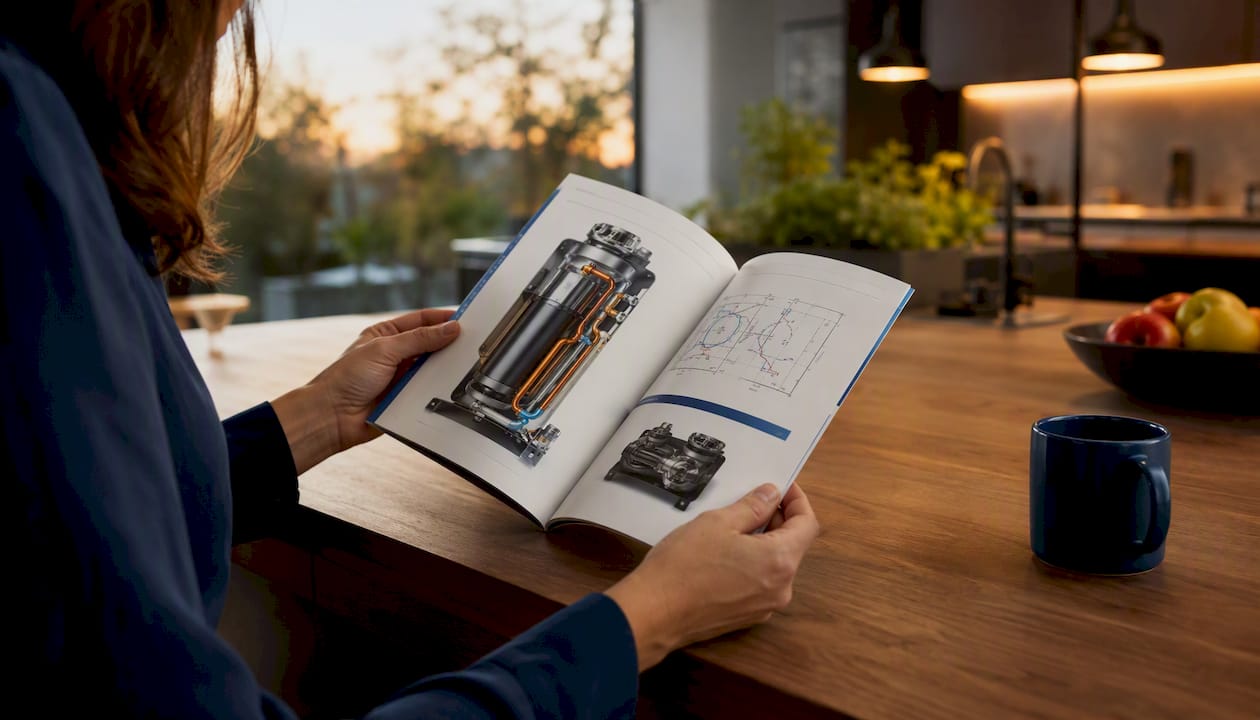
A conventional non-inverter unit behaves like a light switch. The compressor runs at full power until the room hits the target temperature, then cuts out completely. When the temperature drifts, it fires up again at full power. That repeated start-stop cycle draws a surge of electricity each time and puts mechanical stress on the compressor.
An inverter compressor works more like a car’s accelerator. Daikin describes it as the difference between running steadily and repeatedly sprinting from a standstill. Once the room reaches the set temperature, the compressor slows to a gentle maintenance speed rather than switching off. It never has to overcome that energy-hungry start-up surge again.
The practical results are lower electricity consumption, less mechanical wear, and a room that holds a steady temperature rather than swinging between too warm and too cold. Those three things together explain most of the inverter air conditioner benefits that homeowners notice in daily use.
What energy savings can you realistically expect in the UK?
The 30–50% savings figure explained
UK industry data puts typical energy savings at a significant percentage compared with a non-inverter unit. The actual figure you see depends on how long you run the system each day, how well your room is insulated, and whether you use the unit for heating as well as cooling. Someone running a unit six hours a day through a warm summer could save around £54 annually on that cooling use alone, based on the same source’s example calculation.
Use it for winter heating too, and the savings compound. Several UK guides note that homeowners who treat their split system as a year-round heat pump typically see payback within 5–8 years, compared with longer timescales for cooling-only use.
Understanding SEER, SCOP, COP and the ErP label
These four terms appear on every product listing and energy label, and they are worth understanding before you buy.
COP (Coefficient of Performance) is the simplest: it tells you how many units of heat or cooling you get per unit of electricity. A modern inverter split system typically delivers a COP of 3–5, meaning 3–5kW of output for every 1kW consumed. A direct electric heater, by comparison, delivers exactly 1kW per 1kW. That gap is the core financial argument for inverter technology.
SEER (Seasonal Energy Efficiency Ratio) covers cooling performance across a full season. SCOP (Seasonal Coefficient of Performance) does the same for heating. Both are more meaningful than a single-point COP figure because they reflect real-world variation in temperature and load. When comparing models, prioritise SEER and SCOP over headline COP numbers, and check the ErP energy label (the EU-derived rating still used in the UK) to compare units on a like-for-like basis.
Running costs and a simple example
Industry estimates put typical running costs for a residential inverter split at a range depending on load, tariff, and the unit’s efficiency rating. At the lower end of that range, a 2.5kW unit running six hours a day costs under £1 a day.
| Metric | Typical range |
|---|---|
| COP (heating or cooling) | 3–5 |
| Running cost per hour | 10–30p |
| Annual saving vs non-inverter | £54 for six months of daily use (cooling only); higher with heating use |
| Payback period (dual use) | 5–8 years |
Assumptions: standard variable tariff, 6 hours daily use, correctly sized 2.5kW unit. Your actual figures will vary.
Pro Tip: Check whether your installation qualifies for 0% VAT on energy-saving products — eligible heating and cooling installations can reduce the effective upfront cost. Confirm eligibility with your installer before signing off.
What comfort improvements do homeowners actually notice?
Energy figures matter, but the day-to-day comfort difference is what most people talk about after installation.
The most noticeable change is temperature stability. Because the compressor modulates rather than cycling on and off, the room holds its set temperature within a degree or so rather than swinging above and below it. For a bedroom or home office, that consistency is far more pleasant than the warm-cold-warm rhythm of a fixed-speed unit.

Noise is the second thing people notice. The on/off compressor in a non-inverter unit produces a distinct clunk and hum each time it starts. An inverter running at low maintenance speed is considerably quieter, which matters in bedrooms and rooms where you spend long periods working or sleeping.
A correctly sized split system can also reduce a room’s temperature by 8–10°C within 20–30 minutes and dehumidify the space at the same time. That dehumidification effect is underrated in the UK context: a room at 24°C and 40% humidity feels noticeably more comfortable than the same temperature at 70% humidity, which is common during British summers.
Key comfort wins at a glance:
- Steady temperature within 1°C of the set point
- Quieter running, especially at night
- Active dehumidification during cooling mode
- Faster initial cool-down or warm-up than a non-inverter unit
Conservatories and open-plan extensions benefit particularly from these properties, since those spaces are prone to both overheating and high humidity.
What are the real costs and downsides to consider?
The upfront premium
Inverter units typically cost more to purchase than equivalent non-inverter models. On a typical domestic split system, this can translate to a notable price difference. Under average usage assumptions, that premium takes several years to recover through savings on electricity bills alone. Using the unit for heating as well as cooling shortens the payback period.
Repair costs and parts
The inverter drive board and variable-speed compressor are more complex than their fixed-speed equivalents. Replacement parts cost more, and not every local engineer will have experience with every brand’s inverter electronics. This is not a reason to avoid inverter technology, but it is a reason to buy from a brand with strong UK service support and to take out a service plan.
What to check before buying
Run through this checklist at the quotation stage:
- Warranty length — look for at least five years on the compressor, not just the parts
- Parts and labour coverage — confirm whether the warranty covers both, or just parts
- Installer guarantee — separate from the manufacturer warranty; a reputable installer will offer their own workmanship guarantee
- Servicing plan — annual servicing reduces the risk of expensive failures and keeps the unit running at rated efficiency
Red flags worth walking away from: a quote that skips a room survey, an installer who cannot confirm F-Gas registration, or a warranty that covers parts only for the first year.
How do you choose the right inverter air conditioner for your home?
Start here: get a properly sized split system installed by an F-Gas registered engineer. Everything else follows from that.
Sizing your unit correctly
The rule of thumb most engineers use is roughly 100W of cooling capacity per square metre of floor area for a standard UK room with average insulation. A 15m² bedroom therefore needs around 1.5kW; a 25m² open-plan kitchen-diner is closer to 2.5kW. These are starting points, not final answers.
For conservatories, rooms with large south-facing glazing, or open-plan spaces that connect to other rooms, a formal heat-loss and heat-gain calculation is the right approach. The BTU guide on Simcodirect explains how heat output units translate into practical sizing decisions, which is useful background before you speak to an installer.
Pro Tip: Oversizing is as damaging as undersizing. An oversized unit cools the room too quickly, short-cycles before it can dehumidify properly, and ends up running less efficiently than a correctly sized one.
Questions to ask your installer
Before accepting a quote, ask for answers to each of these:
- What SEER and SCOP ratings does this unit carry, and what ErP label does it hold?
- What is the COP at the temperatures typical for this region?
- Does the inverter warranty cover the drive board as well as the compressor?
- Is the external condenser sited where it has adequate airflow and is not exposed to direct afternoon sun?
- Are you F-Gas registered, and can you provide your registration number?
On siting: the external condenser needs clear airflow on all sides and should not be boxed in by fencing or planted directly against a wall. Poor siting reduces efficiency and can void the manufacturer warranty.
For further guidance on heating system controls and how smart thermostats interact with split systems, the Simcodirect blog covers the practical setup in plain terms.
Key takeaways
Inverter air conditioners deliver notable energy savings over fixed-speed units, and their value case for UK homeowners is strongest when the system is used for both heating and cooling year-round.
| Point | Details |
|---|---|
| Energy savings | Inverter units use significantly less electricity than non-inverter models under typical usage. |
| Sizing matters most | An incorrectly sized unit negates efficiency gains; always get a room survey before buying. |
| Dual-use shortens payback | Using the unit for winter heating as well as summer cooling cuts payback to a typical multi-year period. |
| Check the ErP label | Compare SEER and SCOP ratings on the ErP label, not just headline COP figures. |
| Simcodirect’s range | Simcodirect stocks electric heating products and can guide you toward the right solution for your home. |
Why inverter technology is the right call for most UK homes
The conventional wisdom says inverter air conditioners are a luxury purchase that only pays off in hot climates. That framing is wrong for the UK, and it leads homeowners to make the wrong decision.
The real argument is not about summer cooling. It is about replacing or supplementing expensive direct electric heating in winter. A direct electric convector heater delivers 1kW of heat per 1kW of electricity. A modern inverter split system delivers 3–5kW of heat for the same input. That ratio changes the economics entirely, and it applies every time you run the unit in heating mode from October through to April.
The homeowners who feel let down by inverter systems almost always share one of two problems: the unit was sized by guesswork rather than calculation, or it was installed by someone without proper F-Gas registration. Neither of those is a failure of the technology. Both are failures of the buying process.
The other thing worth saying plainly: do not buy an inverter unit if you plan to run it for three weeks in July and nothing else. The financial case depends on year-round use. If your only goal is occasional summer cooling, a smaller, simpler solution may serve you better. But if you want to reduce your heating bills and improve comfort across every season, a properly installed inverter split system is one of the most cost-effective upgrades available to a UK homeowner right now.
Simcodirect can help you find the right heating and cooling solution
If you are weighing up an inverter air conditioner against other electric heating options, Simcodirect offers a broad range of heating products with fast UK delivery and a 30-day returns policy. Whether you are comparing a split system against a smart electric panel radiator or looking for supplemental heating for a specific room, the product range covers both needs.
For bulk orders or commercial installations, Simcodirect offers volume pricing and dedicated support. The product pages carry full specification details including wattage, dimensions, and compatibility notes, so you can make a confident decision before ordering. If you are unsure which solution fits your space, the customer service team can help you work through the options.
Browse the electric heating range at Simcodirect or contact the team directly for guidance on sizing, product selection, and installation considerations.
Useful sources and further reading
A short list of authoritative sources used in this guide, all UK-relevant:
- Boxt: what is an inverter air conditioner? — comfort and performance data including cool-down speed and dehumidification
- GOV.UK: VAT on energy-saving materials and installations — eligibility rules for 0% VAT on qualifying heating and cooling installations
This article provides general information only and does not constitute professional advice. Confirm current VAT eligibility, installer accreditation requirements, and sizing calculations with a qualified F-Gas registered engineer before purchase.