


Ways to modernise a small bathroom in 2026
The most effective ways to modernise a small bathroom combine wall-mounted fixtures, clever storage, and light-amplifying design choices to create a space that feels genuinely larger and more considered. You do not need a full structural overhaul. Even a bathroom under 3m² can feel calm and spacious with the right sequence of changes.
Here is a quick overview of what actually moves the needle:
- Wall-mounted toilets, vanities, and cabinets free up floor area and simplify cleaning
- Compact sanitaryware such as cloakroom basins and short-projection toilets reclaim usable depth
- Wet rooms and sliding or bi-fold doors remove visual barriers that chop up tight spaces
- Recessed shower niches and mirrored cabinets store essentials without protruding into the room
- Large-format tiles, light palettes, and layered lighting make walls and floors read as continuous surfaces
- Mirrors, glazed tiles, and metallic fittings bounce light and add depth without adding bulk
- Wallpaper, patterned floor tiles, and bold accents give a small bathroom personality without clutter
How wall-mounted fixtures modernise a small bathroom
Wall-mounted toilets with concealed cisterns save 200–300mm of floor depth compared with floor-standing models. That is not a trivial gain in a 3m² room. Pair one with a floating vanity unit and a wall-hung storage cabinet, and the floor reads as almost entirely clear, which the eye interprets as significantly more space.
Cloakroom basins save around 100mm of depth compared to standard basins by being more compact. Short-projection toilets reduce total depth compared to standard toilets. Neither change costs much more than a standard fitting, and together they can make the difference between a door that swings freely and one that clips the cistern.
Wet rooms are the single biggest small-bathroom trend in 2026. Removing the shower tray eliminates the visual break that makes a compact space feel chopped up. A minimum footprint sufficient for a wet shower area is compact but requires space for functionality. The catch is that wet rooms require a precise 1:80 floor fall to a linear drain, and tanking must be done properly. Get either wrong and you find out about it through the ceiling below, months later.
Sliding or bi-fold shower doors are a practical alternative when a full wet room is not feasible. They eliminate the door-swing intrusion of a traditional hinged enclosure, which in tight bathrooms can free up more usable circulation space.
Pro Tip: Reversing a standard bathroom door to open outward costs almost nothing and instantly frees 0.3–0.5m² of usable floor area.
Clever storage ideas that keep a small bathroom tidy
Good storage in a small bathroom is about containment, not display. The goal is to keep surfaces clear and the floor visible, which together create the impression of a room that is larger than it actually is.
- Wall-hung vanity units keep the floor clear and provide enclosed storage for the items that accumulate fastest
- Mirrored cabinets do double duty: they replace the mirror you need anyway and hide daily toiletries behind a clean face
- Recessed shower niches provide 100–150mm depth storage without protruding into the room at all
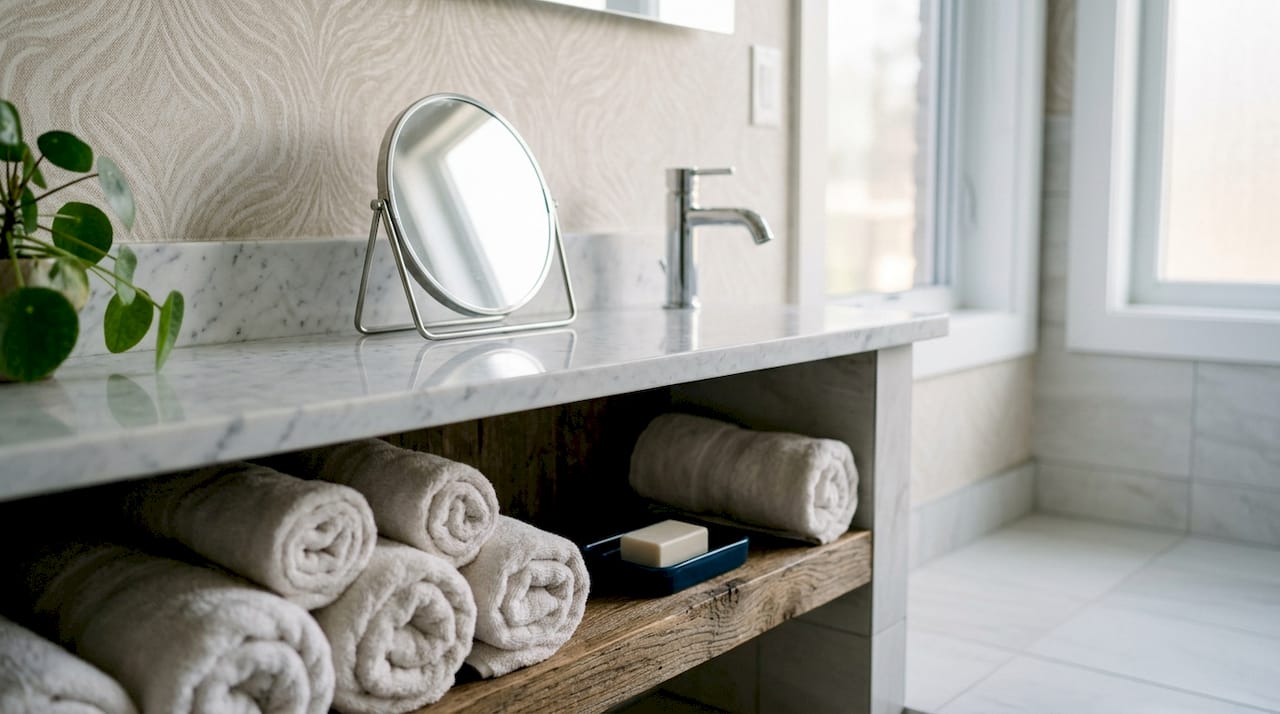
- Shallow shelves of 10–15cm depth suit rolled towels and small baskets without becoming clutter ledges
- Over-toilet slim cabinets or two floating shelves above the cistern use space that is otherwise entirely wasted
- Tall, narrow units of around 300mm width slot beside basins or into corners and maximise vertical space without eating floor area
The mistake most homeowners make is choosing freestanding storage that interrupts floor space and makes cleaning harder. Wall-mounted storage keeps the floor clear and the room easier to read at a glance. Deep drawers and fitted shelving consistently outperform baskets and freestanding racks in tight spaces.
Pro Tip: Rolled towels increase storage density compared with folded ones and look tidier on open shelves. Reserve closed storage for everything else.
For a broader look at space-saving bathroom fittings, including wall-hung options suited to UK homes, Simcodirect’s 2026 guide covers the main categories in detail.
How colour, tiles, and lighting make a small bathroom look bigger
Light, warm neutrals often work well in small bathrooms, with trends pointing towards creamy ivory, soft beige, clay, and terracotta accents. These tones absorb shadow rather than amplifying it, which means the room photographs well and feels calmer at 6am.
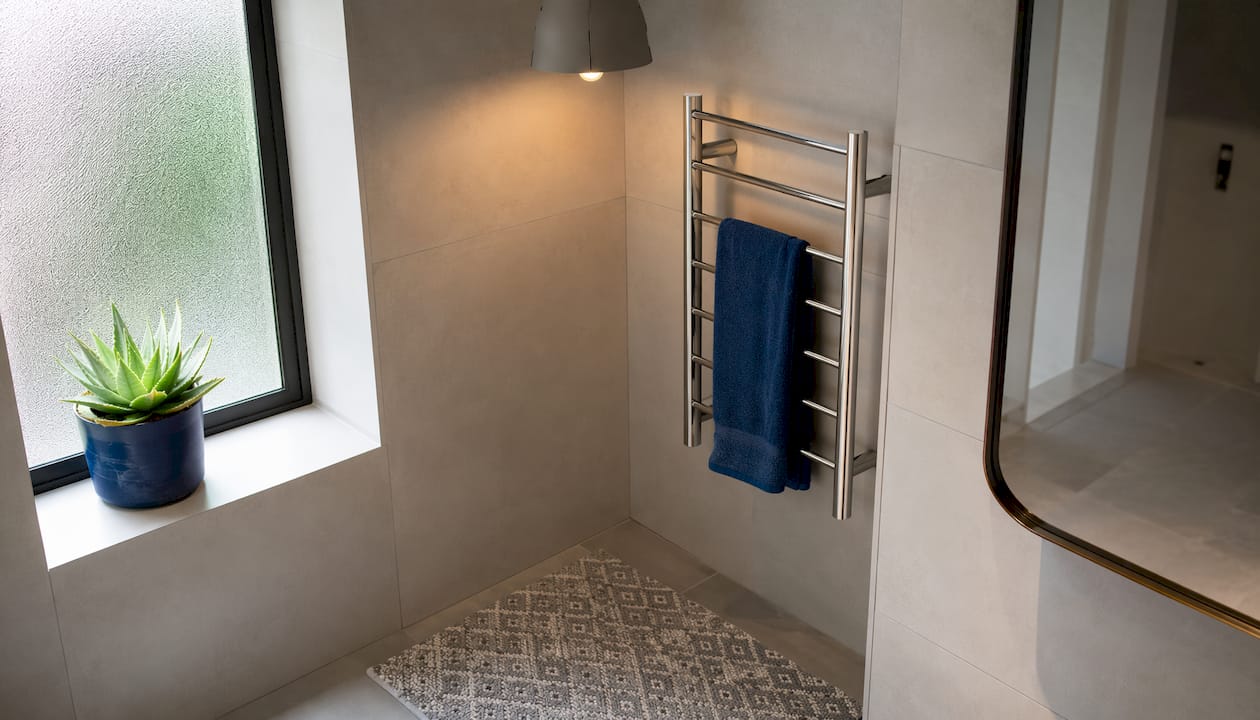
Large-format tiles are one of the most effective visual tools available. 89% of fitters expect demand for smaller or no grout lines, and it is easy to see why. Fewer grout lines mean fewer visual interruptions, and the eye reads the floor and walls as continuous surfaces. Tiles at 600x300mm or 600x600mm also mean fewer cuts and faster installation. Using the same tile on both floor and walls removes the visual break between surfaces entirely.
Glazed tiles add another layer of benefit. Their subtle sheen bounces light around the room, particularly when paired with warm metallic fittings. Even a modest amount of gloss makes a compact room feel more generous.
Lighting deserves more attention than most small bathroom renovations give it. A single ceiling fitting is the equivalent of a single overhead office strip light. The 2026 approach layers three circuits: ambient (downlighters or a flush fitting), task (LED strip around the mirror or under the vanity), and accent (a small light inside a recessed niche or a warm pendant in a corner). Professionally designed layered lighting in a small bathroom can significantly improve the sense of space. For a budget update, simply swapping existing bulbs to LED GU10s improves both light quality and running costs and is relatively inexpensive.
Colour and tile checklist:
- Choose a warm neutral palette rather than stark white
- Use large-format tiles (600x300mm or larger) on both floor and walls
- Match floor and wall tile tones to remove surface boundaries
- Add glazed or gloss tiles in the shower area to bounce light
- Layer ambient, task, and accent lighting on separate dimmable circuits
Adding character to a small bathroom without losing space
The instinct to keep everything neutral in a small bathroom is understandable, but it often produces rooms that feel clinical rather than calm. Character comes from restraint applied in the right places, not from avoiding personality altogether.
Wallpaper works well in a small bathroom provided ventilation is adequate. Pattern adds depth and softness that prevents a compact room from feeling stark. The key is to use it on one wall only, treating it as a focal point rather than a backdrop. Patterned floor tiles achieve a similar effect underfoot. Keep the walls neutral to balance a bold floor, and the room gains personality without feeling busy.
Mirrors of varied shapes and frames add style and dimension without taking up any floor space. A large, frameless mirror above the basin reads as architectural. A smaller, framed mirror in a contrasting material adds a decorative layer. The two can coexist without competing if the frames share a finish, such as brushed brass or matt black.
Warm metallic fittings, particularly brushed brass and brushed nickel, have largely replaced the chrome of the previous decade in UK bathrooms. They add tactile contrast and work well against both warm neutrals and bolder jewel tones. Matt versus gloss textures on tiles and fittings create visual interest without introducing additional colours.
The rule that holds everything together is cohesion. Every time you introduce a new material or colour, you fragment the space. A tight palette of two or three materials, applied consistently, makes a small bathroom feel considered rather than cluttered.
Why large mirrors are the most effective single upgrade
Interior designers are consistent on this point. “Full-height, wall-to-wall mirrors would be top of my list,” says award-winning interior designer Laura Stephens. “They instantly amplify scale and light and create that slightly magical feeling of the room extending beyond its footprint. In a small bathroom, wall-to-wall mirrors, ideally full height, can be transformative. They completely dissolve the boundaries of the room and double both light and colour.”
The effect is amplified when mirrors are combined with lighting. Mounting wall lights directly onto mirror panels creates a reflection of the light source itself, adding depth and atmosphere that a single overhead fitting cannot replicate. A wall-to-wall mirror above the basin costs around £60–£150 and is, by most measures, the single most cost-effective visual upgrade in a small bathroom.
A mirrored medicine cabinet combines the spatial benefits of a large mirror with recessed storage, making it particularly well suited to bathrooms where wall space is limited.
Pro Tip: Go as large as the wall allows. A mirror that extends beyond the width of the basin or runs from the vanity top to the ceiling has far more impact than a small centred one.
How to budget a small bathroom renovation cost-effectively
A complete small bathroom transformation costs around £2,000–£5,000 when focused on cosmetic updates rather than structural changes. The most impactful budget improvements, in order of cost-effectiveness, are regrouting tiles (£150–£300 DIY, or £200–£400 professionally), repainting with moisture-resistant emulsion (£80–£150), upgrading lighting to LED (£50–£200), replacing taps and the shower head (£100–£250), and adding a new mirror and accessories (£60–£150). Done together, this “refresh” approach costs £500–£1,200 and can dramatically improve appearance without touching plumbing or major fixtures.
For wall finishes, moisture-resistant plasterboard meeting BS 5492 standards is the right substrate. A 2.4m x 1.2m sheet costs £12–£18 at Wickes or Travis Perkins, only £3–£5 more than standard board. Bathroom-specific emulsions such as Dulux Easycare Bathroom (£28–£38 for 2.5L) or Crown Bathroom Mid-sheen (£25–£35 for 2.5L) outperform standard emulsion by years in humid conditions.
For tiling, large-format tiles at 600x300mm or 600x600mm minimise grout lines and reduce installation time. Metro tiles remain cost-effective at £18–£30 per m² and suit both traditional and contemporary aesthetics. Selective tiling, covering only the shower enclosure or bath area in full-height tile and using painted plaster elsewhere, reduces costs while maintaining waterproofing where it matters.
Keep plumbing where it is if the existing layout still works. Moving pipework in a compact space increases costs and complexity quickly. Working with what is already there is almost always the smarter financial decision.
DIY tips for modernising a small bathroom yourself
Many of the most impactful small bathroom upgrades are well within DIY reach. The key is knowing which tasks genuinely require a tradesperson and which do not.
Regrouting is one of the most satisfying DIY jobs in a bathroom. Remove old grout with a grout rake (around £8 at Screwfix), clean the joints thoroughly, then apply fresh grout in a contemporary colour such as light grey or white. The result looks like a new tiled surface for a fraction of the cost of retiling. Ronseal One Coat Tile Paint (£25–£35 per litre) covers dated tile colours after thorough degreasing and light sanding.
Swapping taps, replacing a shower head, fitting a new mirror, and installing a mirrored cabinet are all straightforward tasks for a confident DIYer. Fitting a new light fitting in an existing position, provided it is outside the bathroom’s electrical zones, is also manageable. Anything involving new wiring, moving plumbing, tanking a wet room, or fixing wall-hung sanitaryware to a stud wall should involve a qualified tradesperson.
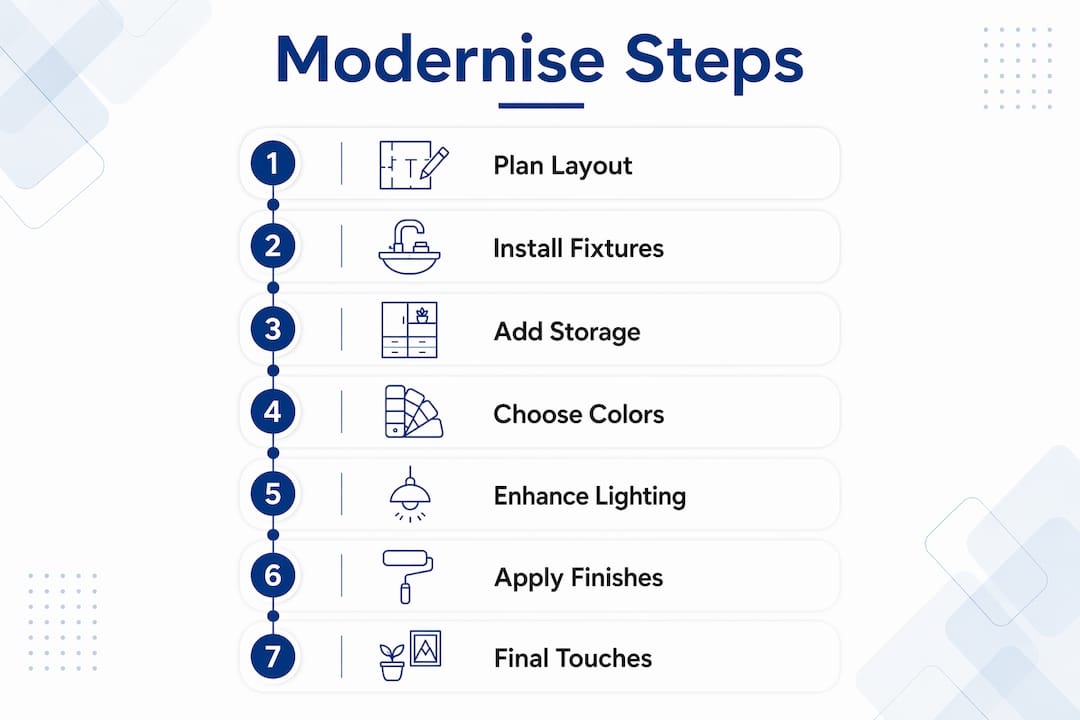
For planning and sequencing, the correct order is: first-fix plumbing and electrics, substrate preparation, plastering where needed, waterproofing, tiling, decorating, then second-fit fixtures. Getting this sequence wrong is the most common cause of rework. A simple scale sketch of the room, with accurate measurements, is enough to test whether a proposed layout actually fits before ordering anything. The UK bathroom renovation planning guide from Simcodirect covers this sequencing in practical detail.
Ventilation and moisture control in a small bathroom
Ventilation is not a finishing touch. It shapes what finishes will hold up over time and what can be installed safely under UK building regulations. A poorly ventilated small bathroom will degrade paint, grout, and even plasterboard within a year or two, regardless of how well the rest of the renovation was executed.
UK building regulations require mechanical extraction in bathrooms without openable windows, and recommend it in all bathrooms regardless. An extractor fan with a humidistat activates automatically when humidity rises, which is the most reliable approach for a small bathroom used frequently. Fans with timers run for a set period after the light is switched off, which suits simpler installations.
For wet rooms, ventilation needs to be sized correctly from the outset. A wet room puts more moisture into the whole space than a conventional shower enclosure, so a standard fan rated for a dry bathroom is often insufficient. Sort ventilation at the design stage, not as a final add-on. For guidance on the right fan type for your layout, Simcodirect’s guide to bathroom ventilation fan types covers the main options for UK homeowners.
Energy-efficient fixtures for a small bathroom
Electric underfloor heating costs £400–£800 in a small bathroom and solves two problems at once: the floor is warm underfoot, and you free up a wall that would otherwise be occupied by a radiator. In a 4m² room, that wall space is often the only sensible position for a towel rail or storage unit.
A slim heated towel rail can replace the radiator without taking on the room’s full heating load, particularly when underfloor heating handles the baseline warmth. Modern electric towel rails are straightforward to install and do not require connection to the central heating system, which keeps installation costs down. LED lighting throughout reduces running costs further. Modern LED GU10 bulbs provide 400–500 lumens while consuming just 5–6 watts, compared with the 35–50 watts of a halogen equivalent.
Touchless taps and thermostatic shower valves reduce water waste without any visible compromise to the bathroom’s appearance. Both are available in the same metallic finishes as standard fittings, so they integrate naturally into a considered scheme.
Flooring options that modernise a small bathroom
The floor is one of the most visible surfaces in a small bathroom and one of the most effective places to either add character or create visual continuity. Large-format porcelain tiles at 600x600mm or 600x1200mm create a sense of continuity that smaller tiles cannot match. Limestone and travertine-look porcelain are the strongest sellers in 2026, offering a warm, sculptural look without the maintenance demands of real stone.
Using the same tile on both the floor and walls, or at least a very similar tone, removes the visual break between surfaces. The eye travels across the space without interruption, which makes the room read as larger. This works particularly well in wet rooms where the seamless transition feels natural.
Patterned floor tiles add personality without overwhelming a small space, provided the walls are kept neutral. Statement flooring in a 4–5m² bathroom typically costs £100–£200 in materials. Vinyl and LVT (luxury vinyl tile) options have improved considerably and offer a practical, water-resistant alternative to ceramic at a lower price point, with some ranges convincingly replicating stone and wood finishes.
For a bathroom with an uneven subfloor, smaller tiles are more forgiving than large-format ones. Large tiles show every dip and hump in the substrate, so plastering and levelling must be correct before the tiler starts.
Choosing and installing modern bathroom taps and mixers
Taps and mixers have an outsized effect on how a bathroom feels, relative to their cost. A single lever basin mixer in brushed brass or matt black immediately reads as contemporary and costs considerably less than replacing the sanitaryware itself. Replacing taps and a shower head typically costs £100–£250 and is one of the highest-return upgrades in a budget refresh.
For a small bathroom, a wall-mounted basin mixer keeps the basin deck clear and reduces visual clutter around the sink. Thermostatic bar shower valves with separate controls for flow and temperature are the current standard for shower installations, offering both safety and a cleaner aesthetic than older concentric valves.
When choosing a mixer, check the water pressure requirements against your system. Gravity-fed systems common in older UK homes often require a pump or a specifically rated low-pressure mixer. Fitting a high-pressure mixer to a low-pressure system produces disappointing results that no amount of good design can compensate for. For fitted bathroom furniture and contemporary tap styles, Bravo London offers a useful reference for current UK design trends.
When installing new taps, always isolate the water supply at the service valves under the basin before starting. Most tap replacements require only basic tools: an adjustable spanner, a basin wrench for reaching the back nuts, and PTFE tape for the connections. If the supply pipes need extending or repositioning, bring in a plumber.
Key takeaways
The most impactful ways to modernise a small bathroom combine wall-mounted fixtures, recessed storage, large-format tiles, and layered lighting to create a space that feels genuinely larger and more considered without requiring structural changes.
| Point | Details |
|---|---|
| Wall-mounted fixtures save real space | A wall-hung toilet saves 200–300mm of floor depth; cloakroom basins save around 100mm over standard sizes. |
| Mirrors are the highest-return visual upgrade | A wall-to-wall mirror above the basin costs £60–£150 and doubles perceived space more effectively than any other single change. |
| Layered lighting costs less than expected | Professionally designed ambient, task, and accent lighting in a small bathroom costs around £200–£500 and significantly improves the sense of space. |
| Budget refresh starts at around £500 | Regrouting, repainting, upgrading lighting, and replacing taps and accessories can transform appearance for £500–£1,200 without touching plumbing. |
| Simcodirect for heating and accessories | Simcodirect stocks electric towel rails, panel radiators, and bathroom accessories suited to small UK bathrooms, with fast delivery and a 30-day returns policy. |
The part most renovation guides get wrong
Most small bathroom guides treat every upgrade as equally worthwhile. They are not. The spatial gains from wall-mounted sanitaryware are real and measurable. The gains from a new colour palette, however carefully chosen, are largely psychological. Both matter, but they matter in a specific order.
The mistake I see most often is homeowners spending heavily on decorative finishes before sorting the fundamentals: ventilation, substrate, and fixture projection. A beautifully tiled bathroom with a mouldy ceiling and a door that clips the basin is not a successful renovation. It is a cosmetic layer over a structural problem.
The other common error is over-caution with character. A small bathroom does not need to be a white box to feel spacious. Bold floor tiles, a single wallpapered wall, or warm metallic fittings add personality without shrinking the room, provided the walls and ceiling stay calm. The designers quoted throughout this guide are consistent on this: restraint applied in the right places is not the same as restraint applied everywhere.
Plan the sequence correctly, get the fixtures right first, and then let the decorative choices reflect what you actually like. A bathroom that feels like yours is more satisfying than one that follows every rule and feels like a show home.
Simcodirect: heating and accessories for your bathroom upgrade
Replacing a bulky radiator with a space-saving heating solution is one of the most practical upgrades in a small bathroom renovation. Simcodirect stocks a range of electric towel rails and panel radiators designed specifically for compact UK bathrooms, including the Platinum Chrome Dual Fuel Curved Towel Radiator, which combines heating and towel drying in a slim wall-mounted profile that frees up the rest of the room.
For rooms where underfloor heating is not feasible, the Dimplex Q-Rad RF Panel Radiator offers smart electric heating in a slimline format that suits modern bathroom schemes. Simcodirect also carries a broad selection of modern bathroom accessories suited to small spaces, from mirrored cabinets to hand dryers for cloakrooms and en-suites. Orders arrive quickly, and a 30-day returns policy means you can order with confidence before committing to installation.