


Towel rail fuse: pick 3A or 5A safely for UK homeowners
Most electric towel rails need a 3A fused spur for lower wattage elements or a 5A fused spur for standard domestic models, and you should only go higher when the manufacturer specifically says so. The overriding rule, backed by IET wiring guidance, is simple: check the product manual first and always fit the smallest fuse that safely covers the element’s wattage. Product pages commonly list the wattage, so that’s a good starting point before touching a screwdriver.
TL;DR:
- Most domestic towel rails requiring a fused spur use a 3A for low wattage or a 5A fuse for standard models, matching the product’s wattage listed on the label.
- Calculating the correct fuse involves dividing the wattage by 230V, with the fuse rating always slightly above the current draw but never exceeding manufacturer recommendations.
- A fused spur provides essential local overcurrent protection and must be installed outside bathroom splash zones with proper RCD safeguards, preferably by a qualified electrician.
- Repeated fuse blows indicate underlying issues like wiring faults or water ingress, not the need for a larger fuse, and should always prompt professional assessment.
- Always verify wattage and protection requirements from product details before installation, and avoid fitting a fuse rated higher than manufacturer guidance to prevent voiding warranties and protect safety.
Table of Contents
- Towel rail fuse rating guide: matching watts to fuse size
- How do you calculate the right fuse size from wattage?
- What is a fused spur and does a towel rail need one?
- Why do towel rail fuses keep blowing?
- When should you bring in a qualified electrician?
- Balancing safety and convenience
- Get the right towel rail and the right specs from the start
- Where to check the details yourself
- Sources
- FAQ
Towel rail fuse rating guide: matching watts to fuse size
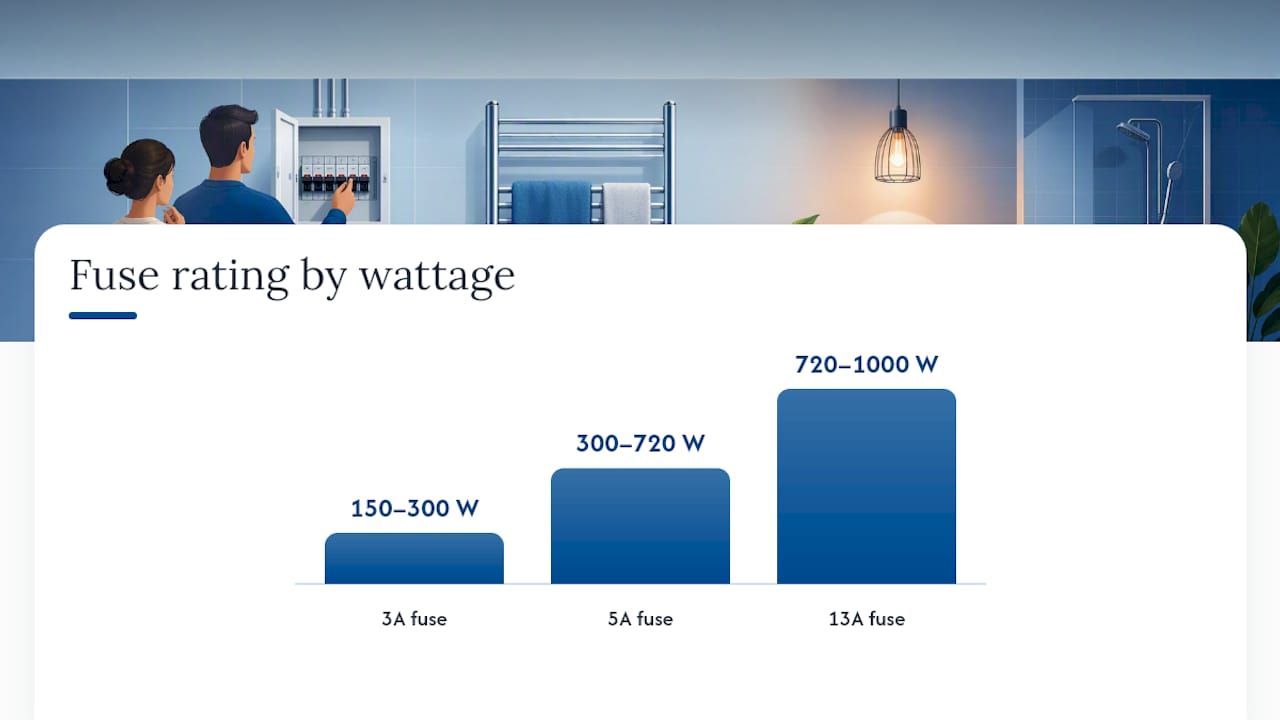
The fuse you fit depends entirely on how much power the element draws, not on habit or what happened to be in the drawer. Retailers and manufacturers generally follow a fairly consistent pattern across the 150 to 1000 watt range that covers almost every domestic towel rail on the market.
Here’s the typical breakdown, based on nominal 230V mains supply:
- Up to roughly 150 to 300W: a 3A fused spur is standard, covering most compact and bathroom-only towel rails.
- Roughly 300 to 720W: a 5A fused spur covers the majority of mid-sized and standard domestic towel rails.
- Above that: you’d assess for a 13A fused spur or, in rarer cases, a dedicated circuit, though this is unusual for a typical domestic towel rail.
Fitting the wrong fuse isn’t just a technical slip. A fuse rated too high can fail to protect the element if a fault develops, and several manufacturers state plainly that using a fuse above their recommended rating can void your warranty outright. That’s worth remembering before you assume a 13A fuse is “safer” because it’s less likely to blow.
Accessories complicate the picture too. A towel rail fitted with a timer or a thermostatic control still draws roughly the same wattage, but dual-fuel rails (which combine mains electricity with a central heating connection) sometimes have separate protection requirements for the electric element alone. Always check the specific product’s technical notes rather than assuming a dual-fuel rail follows the same rule as a purely electric one.
How do you calculate the right fuse size from wattage?
The maths behind fuse selection is genuinely simple, and knowing it means you can double check any manufacturer figure yourself rather than taking it on faith.
The formula is:
Amps = Watts ÷ Volts
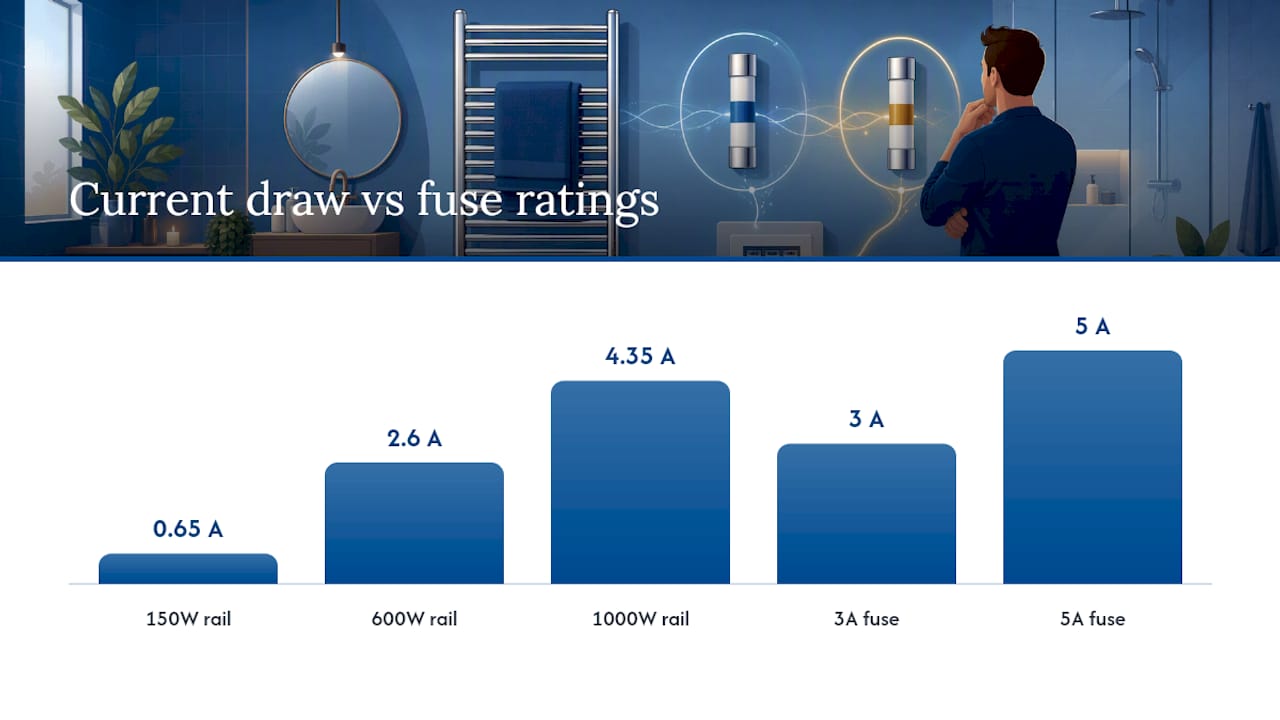
Using 230V as the standard UK mains voltage, here’s how that plays out in practice:
- A 150W towel rail draws 150 ÷ 230 = 0.65A, comfortably inside a 3A fuse.
- A 600W towel rail draws 600 ÷ 230 = 2.6A, which fits neatly under a 5A fuse.
- A 1000W towel rail draws 1000 ÷ 230 = 4.35A, which still sits under 5A but leaves less headroom, so it’s worth checking the manufacturer’s exact recommendation before assuming 5A is right.
Notice the pattern: the fuse rating always sits above the calculated current draw, never below it, but not by an enormous margin either. This is where a lot of confusion creeps in, because people assume “bigger fuse, safer fuse.” It’s the opposite. A fuse’s job is to blow before the wiring or element overheats, so oversizing it removes that protection rather than adding to it.
Pro Tip: If your calculation lands close to a threshold, like that 4.35A example, always check the manufacturer’s manual rather than rounding up yourself. Some manufacturers deliberately specify a 3A fuse even where the maths suggests otherwise, because it accounts for slight variations in mains voltage and continuous running.
What is a fused spur and does a towel rail need one?
A fused spur, or fused connection unit (FCU), is a small wall-mounted unit that sits between your consumer unit and the towel rail itself, providing local overcurrent protection dedicated to that one appliance. The chain runs consumer unit to fused spur to appliance, with the spur holding the correctly rated fuse for that specific device rather than relying on the much larger fuse or breaker protecting the whole circuit.
Towel rails in bathrooms need this local protection partly because of where they sit. Bathroom electrical installations fall under specific zone rules, and a fused spur sited outside the splash zones with appropriate IP-rated housing is the standard approach for wall-mounted heaters and towel rails.
A few things worth checking on any installation:
- The circuit should have RCD protection, which cuts power fast if there’s a fault to earth, a genuinely critical safeguard in a wet room.
- A dedicated fused spur is the norm; running a towel rail off a lighting circuit is sometimes technically possible but rarely advisable and often not compliant with current guidance.
- The spur should be clearly labelled and positioned so it can be isolated quickly, both for maintenance and in an emergency.
If any of this sounds like it strays outside straightforward DIY territory, that’s because parts of it usually do, particularly anything involving new circuits inside bathroom zones.
Why do towel rail fuses keep blowing?
A blown fuse is annoying, but it’s also useful information. It means something drew more current than the fuse allows, and the fuse did exactly its job.
Common causes include a short circuit within the heating element itself, water ingress into a connection point, a fuse that was undersized or oversized for the actual load, poor wiring at installation, or wiring that has simply degraded with age. Before calling anyone out, you can safely check a few things yourself: confirm the wattage printed on the appliance label matches what the fused spur is rated for, and look for any visible signs of moisture or scorching around the connection.
- Check the label wattage against the fuse rating fitted.
- Look for visible moisture, discolouration, or scorch marks near connections.
- Stop and call a qualified electrician if the fuse blows repeatedly, even after checking the fuse size is correct.
Pro Tip: Never respond to a blown fuse by fitting a bigger one “to see if it stops.” Forum reports from UK DIYers consistently show this approach either damages the element further or masks a genuine wiring fault that then goes unaddressed.
When should you bring in a qualified electrician?
Some jobs are genuinely fine for a competent DIYer. Others aren’t, and pretending otherwise around bathroom electrics is how people get hurt or invalidate their home insurance. A qualified electrician should handle installing a new circuit or consumer unit changes, any work inside bathroom zones, fitting or replacing a fused spur, and testing RCDs or measuring element resistance under safe isolation.
Before your electrician arrives, hand over this short list to speed up the visit:
- The exact wattage of the towel rail, taken from the product label or manual.
- Whether the element is wet system, dry electric, or dual-fuel.
- Whether a timer or thermostat is fitted.
- Details of your existing consumer unit and RCD type.
Simco Direct’s towel rail buying guide covers the specs an electrician typically asks for, and product pages list wattage clearly so you’re not guessing on the day.
Balancing safety and convenience
Fitting the correct fuse isn’t complicated, but it does demand a bit of discipline. Follow the manufacturer’s stated rating over any calculation you’ve done yourself, prioritise proper RCD protection above all else, and resist the urge to fit a bigger fuse just because a smaller one keeps tripping. That trip is telling you something. Installation work I’ve seen go wrong almost always traces back to someone assuming bigger meant safer. If you’re unsure, get an electrician to confirm the fuse before you power anything on.
— Carl
Get the right towel rail and the right specs from the start
Some sellers provide electric towel rails, replacement elements, and thermostatic controls with wattage and fitting details listed clearly on product pages, so you’re less likely to guess what fuse to fit. Whether you’re replacing a failed element or choosing a new rail from scratch, the technical specifications on product pages tell you exactly what you’re working with before you order.

If you’re not certain which wattage or element type suits your bathroom, browse the full range on the Simco Direct site or get in touch with customer service, who can talk you through technical questions before you buy. Check the wattage on the product page, match it against the fuse guidance above, and order with confidence that the specs are accurate from the outset.
Where to check the details yourself
- Wave Electrical Solutions on fused spurs in bathrooms for FCU and zone guidance.
- Towel rail FAQ for manufacturer fuse recommendations.
- Simco Direct’s towel rail sizing guide for wattage and product specifics.
Sources
FAQ
What is the recommended fuse rating for a heated towel rail?
Most heated towel rails use a 3A fused spur for lower wattage elements or a 5A fused spur for standard domestic models, following manufacturer guidance rather than a fixed universal rule. Always check the product label first, since it overrides general assumptions.
Does a towel rail need a fused spur?
Yes, a fused spur (fused connection unit) is the standard way to give a towel rail its own dedicated overcurrent protection, separate from the main circuit fuse or breaker. This is particularly important in bathrooms, where zone rules and RCD protection apply to fixed appliances.
How many amps does a heated towel rail use?
It depends on wattage, but you can calculate it using amps equals watts divided by 230 volts. A 600W towel rail draws around 2.6A, while a 1000W model draws roughly 4.35A, both comfortably within a 5A fused spur.
Does a heated towel rail need its own circuit?
A dedicated fused spur is the standard approach rather than a full separate circuit in most domestic setups, though the exact requirement depends on the property’s existing wiring and consumer unit. Running it from a general lighting circuit isn’t advisable, and a qualified electrician should confirm the right approach for your home.