


Radiator valve types: the UK homeowner's practical guide
For most rooms in a UK home, fit a thermostatic radiator valve (TRV). Keep the lockshield valve on the return side for system balancing, and consider a smart TRV only where room-level scheduling or remote control genuinely adds value to your routine.
The three functional categories you need to know are:
- Manual valves — simple on/off control, no automatic regulation
- Thermostatic radiator valves (TRVs) — sense room air temperature and adjust flow automatically
- Smart TRVs — app-controlled, schedulable, and remotely adjustable
Two additional types complete the picture: lockshield valves (the balancing valve on the return side of every radiator, not a control valve) and dual-fuel valves (used on towel rails that can run on either central heating or an electric element).
According to Boiler Guide’s radiator valve explainer, TRVs and smart TRVs provide increasing levels of automatic, room-level control compared with manual valves. For most UK homeowners, TRVs are the right starting point. Simcodirect stocks both an Essential Manual Radiator Valve and a TRV range for straightforward replacement or upgrade.
Pro Tip: Before ordering any valve, note which side your pipework enters the radiator — this determines whether you need a straight, angled, or corner body, and getting it wrong means a return trip.
Key takeaways
For most UK homes, fitting TRVs across general rooms and leaving the lockshield correctly set delivers the best balance of comfort, efficiency, and cost.
| Point | Details |
|---|---|
| TRVs suit most rooms | Thermostatic valves regulate temperature automatically and suit bedrooms, living rooms, and hallways. |
| Match body style to pipework | Measure pipe entry direction before ordering: angled for floor-rise pipes, straight for in-line, corner for wall-entry. |
| Measure before you buy | Check tail thread (typically ½ inch BSP) and pipe compression size (typically 15mm) to avoid returns. |
| Balance before upgrading | Check lockshield settings and bleed radiators before spending on smart TRV heads. |
| Simcodirect for replacements | The Essential Manual Radiator Valve and TRV range are available with sizing guidance and fast UK delivery. |
Table of Contents
- What are the main radiator valve types and how do they differ?
- Straight, angled, or corner: which valve body fits your pipework?
- Why the lockshield valve matters more than most homeowners realise
- Compatibility and common UK sizes: measure before you order
- Which valve should you choose for each room?
- Installing or replacing a valve: what to expect
- Why balancing matters more than upgrading to a smart head
- A retailer’s perspective on the mistakes homeowners make
- Simcodirect’s radiator valve range: straightforward shopping with support
- Sources
What are the main radiator valve types and how do they differ?
Understanding the differences between valve types saves you money, avoids wasted heat, and keeps your heating system running efficiently. Here is what each one actually does.
1. Manual radiator valves
A manual valve is essentially a tap. Turn it clockwise to restrict flow, anticlockwise to open it. There is no sensor, no thermostat, and no automatic response to room temperature. You set it and forget it — until the room gets too warm or too cold, at which point you adjust it by hand.
British Flow Control’s UK radiator valve guide notes that manual valves remain common on older radiators but are rare on modern new-builds. They suit budget-focused situations or radiators in rooms you rarely use and are happy to leave at a fixed output.
Pros: Inexpensive, simple, nothing to break mechanically. Cons: No automatic temperature regulation, wastes energy if left fully open, requires manual adjustment every time conditions change.
2. Thermostatic radiator valves (TRVs)
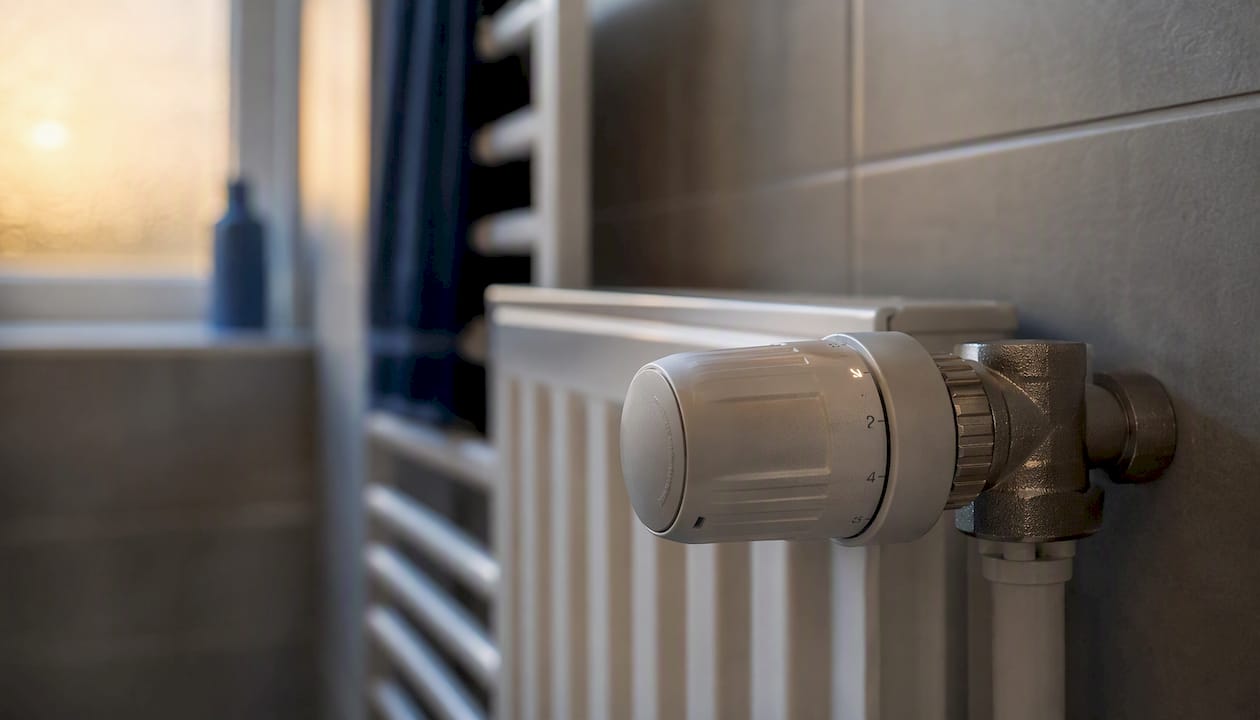
A TRV has a sensor head filled with a wax or liquid element that expands as the room warms. When the room reaches the target temperature, the element pushes a pin that closes the valve and reduces hot-water flow. As the room cools, the element contracts, the pin retracts, and flow resumes. No electricity required.
The dial typically runs from 0 to 5, with each number corresponding to an approximate temperature band. The frost or asterisk (*) setting keeps the valve just cracked open to prevent freezing — useful in bathrooms or holiday homes. British Gas explains that TRVs let homeowners set a target temperature per room, improving both comfort and efficiency over manual alternatives.
Pros: Automatic room-level control, no electricity needed, widely available, compatible with most UK systems. Cons: Slightly higher upfront cost than manual, sensor head can stick or fail over time, needs clear airflow around the head (not behind curtains or furniture).
3. Smart TRVs
Smart TRVs replace the standard wax-element head with a motorised, app-connected unit. You set exact temperatures and schedules from your phone, and some models integrate with voice assistants or whole-home smart heating systems. British Gas confirms that smart TRVs allow precise temperature selection and remote scheduling beyond what a standard TRV head can do.
The scheduling benefits are most tangible in rooms with irregular occupancy — a home office used only on certain days, or a guest bedroom that needs warming an hour before arrival.
Pros: Remote control, precise scheduling, energy data visibility, ideal for irregular-use rooms. Cons: Higher cost, requires batteries or charging, app dependency, overkill for rooms with predictable daily patterns.
4. Dual-fuel valves
Dual-fuel valves are specific to towel rails and heated towel radiators. They allow the rail to run from the central heating circuit in winter and switch to an independent electric element in summer, so you get warm towels year-round without firing up the boiler. If you have a Consort Toweldry towel radiator or a similar dual-fuel rail, you need a valve set designed for that configuration. Standard TRVs do not apply here.
5. Lockshield valves
The lockshield sits on the return (outlet) side of every radiator and is covered by a plastic cap. Its job is not temperature control — it restricts return flow to balance heat distribution across the whole system. Maintracts explains that a lockshield is typically adjusted once by an installer during commissioning and then left alone. Turning it casually can throw the entire system out of balance.
Straight, angled, or corner: which valve body fits your pipework?
The valve body style is determined entirely by how your pipes enter the radiator. Getting this wrong is the most common ordering mistake, and it cannot be fixed with a washer.
Boiler Guide confirms that valve body shape — straight, angled, corner, or H-block — is dictated by pipework layout, and choosing the correct style delivers a neat fit and proper flow.
- Straight valves — used when the pipe runs horizontally along the floor and enters the radiator from directly below, in line with the valve inlet. Common on older properties with exposed pipework.
- Angled valves — the most common type in UK homes. Used when the pipe comes up from the floor at 90° and connects to a horizontal radiator inlet. The valve body turns the flow through a right angle.
- Corner valves — used when the pipe enters from the wall behind the radiator rather than the floor. Less common but essential when pipework is chased into the wall.
- H-block (or twin-entry) valves — used on certain panel radiators where both flow and return connections are at the bottom centre of the radiator. Common on some modern flat-panel designs.
Before you buy, run through this quick check:
- Stand in front of the radiator and look at the bottom corners.
- Trace where the pipe comes from: floor (below) or wall (behind)?
- If the pipe comes up from the floor and bends to meet the radiator inlet, you need an angled valve.
- If the pipe runs straight up and meets the inlet without bending, you need a straight valve.
- If the pipe exits the wall horizontally at radiator height, you need a corner valve.
Pro Tip: Measure the centre-to-centre distance between your two valve inlets before ordering. On some radiators this is non-standard, and a replacement valve with a different body length will not reach.
Why the lockshield valve matters more than most homeowners realise
The lockshield is the most overlooked component in a domestic heating system. Most homeowners have never touched it, which is usually correct — but understanding what it does helps you diagnose problems that look like boiler or TRV faults.
Maintracts’ lockshield guide describes its role clearly: it controls the flow leaving a radiator to help balance the system, and is typically adjusted once by an installer rather than regularly by the homeowner.
Signs your system may be out of balance:
- Radiators near the boiler heat up quickly; those at the far end of the circuit stay cold or take much longer.
- The top of a radiator is cold while the bottom is warm (a different issue — likely air, so bleed it first).
- Some rooms overheat while others never reach a comfortable temperature, even with TRVs fitted.
What a homeowner can sensibly do:
- Bleed radiators first — trapped air causes many symptoms that look like balance problems.
- Check that lockshield caps are in place and have not been knocked open.
- Confirm TRV heads are not stuck (press the pin on the valve body; it should move freely).
If bleeding and checking TRVs does not resolve uneven heating, call a heating engineer to rebalance the system. Rebalancing involves measuring flow and return temperatures at each radiator and adjusting lockshields methodically — it is not a casual DIY job.
Compatibility and common UK sizes: measure before you order
Buying the wrong size valve is the single most avoidable mistake in a radiator valve swap. The Heating Hub’s TRV buyer’s guide is clear: measuring tail diameter and thread type before purchase is non-negotiable.
Step-by-step measurement guide:
- Identify the tail thread size. The tail is the short threaded stub that screws into the radiator. The most common UK size is ½ inch BSP (British Standard Pipe). Some older radiators use ¾ inch.
- Measure the pipe diameter. The compression fitting on the valve body connects to your copper pipe. Common UK sizes are 8mm, 10mm, and 15mm, with 15mm being standard on most modern domestic systems.
- Check the valve body orientation (straight, angled, corner) as described above.
- Note the thread type. Most UK valves use compression fittings on the pipe side and BSP on the radiator tail side. If your existing pipework uses push-fit or another system, you may need an adaptor.
- Measure tail length. Some radiators have extended tails, and a standard-length valve body may not reach the pipe without an extension piece.
Common UK sizes at a glance:
| Measurement | Common UK sizes | Notes |
|---|---|---|
| Radiator tail thread | ½ inch BSP | ¾ inch BSP on some older radiators |
| Pipe compression size | 15mm | 10mm and 8mm on smaller or older systems |
| Valve body orientation | Angled (most common) | Straight or corner depending on pipework |
Adaptors are available when sizes differ, but a clean like-for-like replacement is always preferable. Simcodirect’s Essential Manual Radiator Valve product page lists compatible tail and pipe sizes, which is a useful cross-reference when measuring up.
Which valve should you choose for each room?
The right valve depends on three things: how much control you want, how the room is used, and your budget. Here is a practical room-by-room framework.
Decision priorities:
- Budget first: manual valve — low upfront cost, no automation.
- Comfort first: TRV — automatic temperature maintenance per room.
- Schedule or remote control: smart TRV — worth the extra cost for irregular-use rooms.
- Bathroom towel rail: dual-fuel valve set if you want summer-only electric operation.
| Room | Recommended valve | Control level | Notes |
|---|---|---|---|
| Living room | TRV | Set temperature | High-use room benefits most from automatic regulation |
| Bedroom | TRV | Set temperature | Set lower overnight; frost setting useful when away |
| Bathroom | TRV or dual-fuel | Set temperature | Use frost setting; dual-fuel if towel rail runs electric in summer |
| Home office | Smart TRV | App/schedule | Irregular occupancy makes scheduling worthwhile |
| Hallway | Manual or TRV | Manual/set temp | Often lower priority; manual acceptable if budget is tight |
| Guest bedroom | Smart TRV | App/schedule | Pre-heat remotely before guests arrive |
For bathroom radiator placement and valve considerations, Simcodirect’s bathroom radiator placement guide covers the specifics of towel rail positioning and valve access.
Installing or replacing a valve: what to expect
A straightforward valve swap on an accessible radiator is within reach for a competent DIYer. A radiator removal, a system with persistent pressure problems, or any work touching the boiler itself calls for a qualified plumber.
Step-by-step valve replacement checklist:
- Isolate the radiator. Close the TRV (turn fully clockwise) and close the lockshield valve (count the turns so you can return it to the same position).
- Protect the floor. Place towels and a shallow tray under the valve — some water will escape.
- Loosen the valve union nut. Use an adjustable spanner on the union nut and a second spanner to hold the valve body steady. Water will drain from the radiator as you loosen.
- Remove the old valve. Unscrew the tail from the radiator if replacing the full valve assembly.
- Fit the new valve. Wrap the tail threads with PTFE tape (three to four turns), screw in the new tail, and connect the valve body. Hand-tighten first, then spanner-tighten — do not overtighten compression fittings.
- Refill and check for leaks. Open the lockshield to its previous position, then slowly open the new valve. Check all connections for drips.
- Bleed the radiator. Use a bleed key to release any trapped air until water flows steadily.
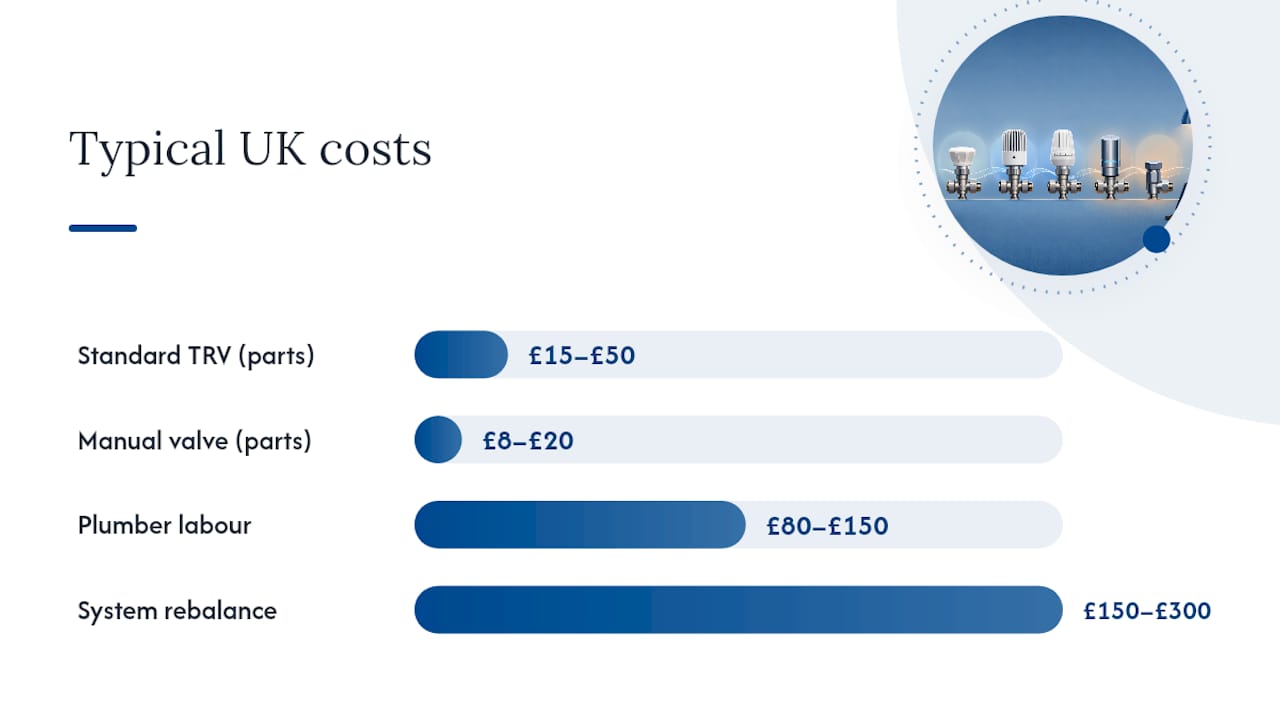
Typical UK costs (2026 indicative ranges):
- DIY parts only: £15–£50 for a standard TRV, £8–£20 for a manual valve.
- Plumber labour: £80–£150 for a single valve swap, depending on location and access.
- Full system rebalance by a heating engineer: £150–£300 depending on system size.
These are indicative ranges, not fixed quotes. Costs vary by region and system complexity.
Safety note: Never work on a pressurised system without isolating it first. If your system uses a sealed (pressurised) circuit rather than an open-vented tank in the loft, be aware that draining even a small amount of water will drop system pressure. You will need to repressurise via the filling loop before firing the boiler. If you are unsure whether your system is sealed or open-vented, check with a qualified plumber before starting.
Why balancing matters more than upgrading to a smart head
Heating engineers consistently make a point that most homeowners miss: a well-balanced system with correctly set lockshields often delivers more comfort and efficiency than simply swapping standard TRV heads for smart ones.
Fitting smart TRV heads to a poorly balanced system is like fitting a precision throttle to a car with a blocked fuel line. The head can only regulate what flow reaches it — if the lockshield is set too open or too closed, the radiator will not perform correctly regardless of how sophisticated the control head is. Get the balance right first, then consider upgrading the heads.
Boiler Guide’s analysis supports this: heating engineers emphasise that system balance and correct valve sizing often produce larger efficiency and comfort gains than head upgrades alone.
What a competent DIYer can do safely:
- Bleed all radiators to remove trapped air.
- Check that every TRV head moves freely (press the pin; it should spring back).
- Confirm lockshield caps are in place and have not been disturbed.
- Replace a faulty or sticking TRV head with a compatible replacement (most heads are interchangeable across brands using standard ½ inch fittings).
- Set the frost setting on TRVs in bathrooms or unoccupied rooms.
Pro Tip: If you have a room that never reaches temperature despite a working TRV, check the lockshield on that radiator before assuming the TRV is faulty. A lockshield closed too far restricts flow regardless of what the TRV head is doing.
For a broader view of how heating controls interact, Simcodirect’s heating system controls guide covers programmers, thermostats, and TRVs as a connected system.
A retailer’s perspective on the mistakes homeowners make
The most common mistake I see is homeowners ordering a valve based on appearance rather than pipework orientation. A chrome angled valve looks identical to a chrome straight valve in a product photo — the difference only becomes obvious when you try to connect it and the pipe is pointing the wrong way.
The second most common issue is replacing a TRV head without checking whether the pin on the valve body is stuck. A new head on a seized body will not work. Press the pin before ordering a replacement head; if it does not move, you need the full valve assembly, not just the head.
Simcodirect’s valve category includes both the Essential Manual Radiator Valve for straightforward replacements and a TRV range for homeowners upgrading from manual control. Product pages include sizing information to help you match the valve to your existing pipework before purchase.
Simcodirect’s radiator valve range: straightforward shopping with support

Simcodirect stocks manual radiator valves and TRVs with clear sizing information on each product page, so you can confirm compatibility before adding to your basket. The Essential Manual Radiator Valve suits budget-focused replacements and infrequently used radiators. For towel rails, the Titan Chrome Straight Towel Radiator and Platinum Chrome Electric Curved Towel Radiator pages include compatible valve guidance. All orders come with fast UK delivery and a 30-day returns policy. If you have a measurement or fitting question before ordering, Simcodirect’s customer support team can help you confirm the right valve for your system.
Sources
- Radiator valves explained: Manual, TRVs & smart | Boiler Guide
- Radiator Valves Guide UK | Types, TRVs & buying advice — British Flow Control
- What is a lockshield valve? How it works & how to adjust it | Maintracts
- What is a thermostatic radiator valve? - British Gas