


Oil filled radiator costs: what you'll actually pay
A 1,500W oil-filled radiator costs roughly 39p an hour to run flat out, or about £1.56 for four hours, based on the current Ofgem Direct Debit unit rate of 26.11p per kWh. A smaller 400W model will cost proportionally less per hour, while a 2,000W radiator running continuously costs correspondingly more, based on the same unit rate. Those figures sit at the top end, though, because a thermostat rarely lets the element run at full power the whole time.
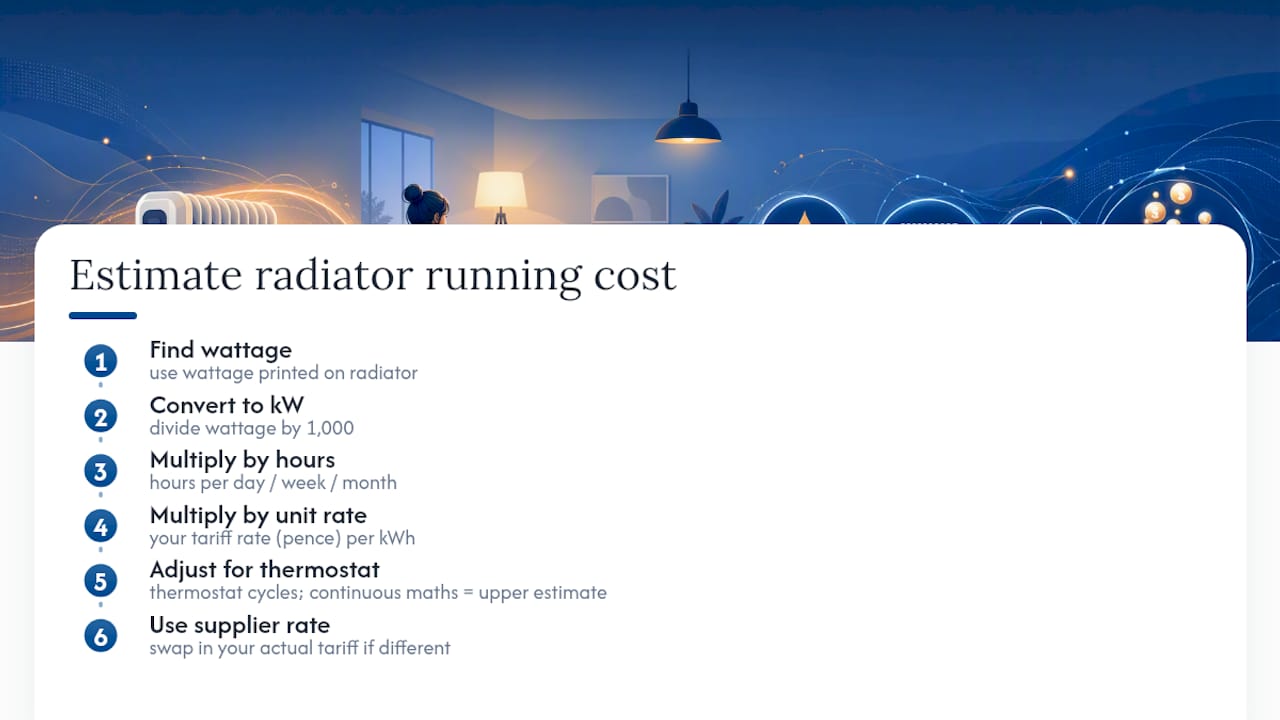
The basic formula is: Power in kW multiplied by hours used and price per kWh in pence equals cost in pence. Divide the wattage by 1,000 to get kilowatts and multiply accordingly with your actual unit rate to find the approximate cost.
In practice, once a room reaches your target temperature, the thermostat cuts the element out and only kicks back in when the room cools.
Key Takeaways
Running an oil-filled radiator costs an amount proportional to wattage at the current unit rate, but real-world bills can be significantly lower due to thermostat cycling reducing power usage.
| Point | Details |
|---|---|
| Use the formula | Multiply kW by hours used by 26.11p, then divide by 100 for pounds. |
| Maximum isn’t reality | Thermostat cycling means actual costs often run well below the full-power hourly figure. |
| Match wattage to room | Roughly 100W per square metre avoids both underheating and wasteful overheating. |
| Prefer one room over the whole house | Central heating usually wins on cost for heating an entire home for months at a time. |
| Choose controls carefully | Simcodirect’s thermostatic radiators, including the Dimplex Q-Rad, are built to keep duty cycle, and cost, in check. |
Table of Contents
- What is an oil-filled radiator and how does it work?
- How much electricity do oil-filled radiators use?
- How to calculate running costs in the UK
- What changes the actual running cost?
- Daily, weekly and monthly costs by room size
- How does an oil-filled radiator compare with other heating options?
- How can you reduce the running cost?
- What’s the official rate, and how much does thermostat cycling really change things?
- Are oil-filled radiators expensive to run?
- Why this matters more than most homeowners realise
- How Simco Direct can help you choose the right radiator
- Frequently asked questions
- Sources
What is an oil-filled radiator and how does it work?
An oil-filled radiator is a sealed metal column filled with thermal oil, heated by an electric element inside its base. It never needs topping up or replacing. The element warms the oil, the oil circulates through the finned columns, and the whole unit radiates heat into the room long after the element itself has switched off.

That last point is what makes oil-filled radiators different from a fan heater or a bar heater. The oil has thermal mass, meaning it absorbs and stores heat rather than releasing it all instantly. Switch the radiator off and it will keep the room warm for a further 20 to 40 minutes, depending on size and room conditions, because the oil is still cooling down and giving off heat as it does. Expert Reviews confirms this heat retention as one of the category’s defining traits.
Most modern units come with an adjustable thermostat, some form of timer, and two or three heat settings that let you run fewer of the internal elements at once. Cheaper models sometimes skip the thermostat altogether, which is worth checking before you buy, since it’s the single biggest factor in whether your bills stay low or creep up.
- Pro: retains heat well after switching off, so you get “free” warmth for a while.
- Pro: portable, no installation or gas safety certificate needed.
- Con: slow to warm a room from cold compared with a fan heater.
- Con: heavier and bulkier to move between rooms than a convector.
How much electricity do oil-filled radiators use?
Every oil-filled radiator is rated in watts (W), and the conversion to kilowatts is straightforward: watts ÷ 1,000 = kW. A 1,500W radiator is 1.5kW. A 2,000W radiator is 2kW. That kW figure is what you plug into the running-cost formula.
UK retailers typically sell oil-filled radiators in these wattages, each suited to a rough room size:
- 400W to 600W – small rooms, box rooms, or as a supplementary heat source (up to roughly 10m²)
- 1,000W – medium bedrooms or home offices (around 10 to 14m²)
- 1,500W – larger bedrooms or small living rooms (around 14 to 18m²)
- 2,000W to 2,500W – larger living rooms or open-plan spaces (18m² and above)
Expert Reviews suggests a rough sizing rule of around 100W per square metre for an averagely insulated UK room, which is a sensible starting point if you’re unsure what you need. It’s worth remembering that the wattage printed on the box is the maximum draw, not what the radiator uses continuously. Once the thermostat is satisfied, actual consumption drops well below that peak figure, sometimes to zero for stretches of ten or fifteen minutes at a time.
How to calculate running costs in the UK
The maths is the same regardless of wattage. Take the power in kW, multiply by hours of use, multiply by the pence-per-kWh rate, then divide by 100 to get pounds. As of the Q3 2026 price cap (1 July to 30 September 2026), the Ofgem Direct Debit standard unit rate for electricity is 26.11 pence per kWh.
These are worst-case figures based on continuous full-power use. Ofgem’s breakdown of the price cap also sets a daily standing charge, which you pay regardless of how much electricity you use. For a single evening’s use of a portable heater, the standing charge is irrelevant to the calculation above, since you’re paying it anyway for your fridge, lights and everything else in the house. It only matters if you’re comparing your total monthly bill against a scenario where you used no electricity at all, which isn’t realistic for most households.
- If you’re on Economy 7 or another time-of-use tariff, swap 26.11p for whichever rate applies to the hours you’re actually heating (day rate or night rate).
- Check your own tariff on your latest bill or supplier portal rather than assuming you’re on the standard variable rate.
Ofgem also revised the Typical Domestic Consumption Values used to calculate headline annual bill figures for this quarter, which is worth knowing if you see slightly different “average household” numbers quoted elsewhere; they’re based on a medium-use household consuming around 2,500 kWh a year, not a single appliance.
What changes the actual running cost?
The formula gives you a ceiling, not a bill. Several things push real-world costs up or down from that maximum figure.
- Room size and ceiling height – a bigger volume of air needs more energy to heat, so an underpowered radiator will run at full duty cycle almost constantly, chasing a temperature it can’t quite reach.
- Insulation quality – solid walls, single glazing and gaps under doors mean heat escapes faster, so the element switches back on more often.
- Desired temperature – every extra degree on the thermostat adds noticeably to the duty cycle over an evening.
- Thermostat accuracy – a cheap mechanical dial can overshoot by a couple of degrees before cutting out, wasting energy; a digital thermostat with a timer is usually tighter.
- Placement and draughts – a radiator stuck behind a sofa or under a draughty window works harder than one with clear airflow in a sheltered spot. Our guide to radiator placement covers this in more depth for bathrooms, but the same airflow principles apply in any room.
Pro Tip: Buying a radiator that’s slightly oversized for the room isn’t wasteful, it’s often cheaper in practice. An oversized unit reaches your target temperature quickly, then cycles on and off gently, whereas an undersized one runs at 100% duty cycle almost permanently trying to keep up, which usually costs more over an evening.
Daily, weekly and monthly costs by room size
Turning the hourly figures into something closer to a real bill means factoring in typical hours of use and a realistic duty cycle rather than continuous full power. The table below assumes a thermostat is fitted and set to a comfortable working temperature, with the radiator cycling rather than running flat out throughout.
These figures are built on continuous-rate maths for consistency, so treat them as an upper estimate.
To work out your own numbers, take the wattage printed on your radiator, divide by 1,000, multiply by however many hours you plan to use it, then multiply by your own unit rate in pence. Swap in your supplier’s actual rate if you’re not on the standard variable tariff, since Direct Debit, prepayment and standard credit rates can differ.
How does an oil-filled radiator compare with other heating options?
For heating a single occupied room, an oil-filled radiator tends to be one of the more cost-effective electric options because of its steady, retained heat. It’s a different story if you’re trying to heat an entire house for months on end.
- Versus gas central heating: gas is typically cheaper per kWh than electricity, so heating a whole home via the boiler usually beats running several electric radiators simultaneously. An oil-filled radiator makes more sense for heating one room without firing up the whole system, particularly outside the main heating season.
- Versus fan heaters: fan heaters warm a room faster but stop producing heat the instant they’re switched off, with no residual warmth. Oil-filled radiators are slower to start but keep giving heat back afterwards.
- Versus convector heaters: convectors heat air quickly but that warmth escapes faster once the unit is off, similar to fan heaters. Oil-filled units win on steady, lingering warmth; convectors win on speed.
- Versus heat pumps: heat pumps are far more efficient over a whole heating season but involve significant upfront installation cost and aren’t a fair comparison against a £60 portable radiator for occasional single-room use.
The practical takeaway is that oil-filled radiators are best suited to topping up warmth in one room, a spare bedroom, a home office, or a conservatory, rather than replacing central heating across an entire house.
How can you reduce the running cost?
- Match the wattage to the room. Oversizing slightly is fine; undersizing forces constant full-power running, which costs more over an evening than a correctly sized unit.
- Use the thermostat properly. Set it to the lowest comfortable temperature rather than maximum, and let it cycle naturally.
- Add a timer. Heat the room for the hour before you need it and the hour you’re in it, not all afternoon on the off-chance.
- Close the door. Heating a room with the door open means heating the hallway too.
- Draught-proof windows and gaps under doors. Cheap foam strips can noticeably cut how often the element fires.
- Position for airflow. Don’t box the radiator in behind furniture or curtains; blocked airflow means it works harder for less warmth in the room.
- Keep the fins clean. Dust reduces how efficiently the unit radiates heat into the room.
Pro Tip: A timer and a thermostat working together beat either one alone. The timer stops you heating an empty room; the thermostat stops you overheating an occupied one. Combined, they’re usually the single biggest lever on your actual monthly cost.
If your home has broader insulation gaps, such as poor loft insulation or old cavity walls, it’s worth checking whether you qualify for support through government-backed insulation schemes before assuming a new radiator is the answer. The Ofgem sources listed at the end of this article are a sound starting point for checking current eligibility.
What’s the official rate, and how much does thermostat cycling really change things?
Every calculation in this article uses the Ofgem Direct Debit standard unit rate for Q3 2026, 26.11 pence per kWh, alongside the standing charge Ofgem publishes for the same period. Ofgem reviews the price cap every quarter, based on wholesale energy costs, network costs and operating costs, so the exact figure will shift again after September 2026. If you’re reading this later in the year, swap in whatever rate is current on your bill.
The nuance that consumer guides consistently flag is that a “cost per hour” figure is a ceiling, not a prediction. Thermostatic controls switch the element off once the room hits your set temperature, and it only fires again once the room drops a degree or two below that. In a well-insulated room, that can mean the element is genuinely drawing power for well under half the time it’s switched on at the wall.
If you want to know exactly what your radiator costs in your specific room, an inexpensive plug-in energy monitor will tell you far more than any published table. Run it for a full evening, note the kWh used, and multiply by your unit rate. That single test gives you a real number for your home rather than a generic estimate, and it takes the guesswork out of any monthly projection.
Are oil-filled radiators expensive to run?
Not for what they’re designed to do: an oil-filled radiator is one of the more economical ways to heat a single occupied room, but it’s not a substitute for central heating across a whole house for months at a time.
- Good fit: spare rooms, home offices, conservatories, topping up a chilly room without heating the rest of the house.
- Poor fit: heating an entire home continuously through winter, or replacing a functioning gas boiler outright.
- Rule of thumb: if you’re heating one room for a few hours, an oil-filled radiator with a decent thermostat is usually cheaper than firing up the whole central heating system. If you need consistent warmth throughout the house for most of the day, gas central heating typically works out cheaper per kWh.
The decision usually comes down to how many rooms you actually need warm at once, not which appliance sounds more efficient on paper.
Why this matters more than most homeowners realise
Most guides to oil-filled radiator running costs stop at the maximum wattage figure, which flatters neither the appliance nor the reader. The number that actually determines your bill is duty cycle, how much of the time the element is genuinely drawing power, and that depends far more on your thermostat and your insulation than on the wattage printed on the box.
The mistake I see most often is homeowners buying the biggest radiator they can find “to be safe,” assuming bigger means warmer for less. In a small, well-insulated room, an oversized radiator without a decent thermostat can cost more than a correctly sized one, simply because cheap thermostats on big units tend to overshoot before cutting out. Wattage matters, but it’s the second decision. The first is whether the unit has a thermostat you trust to do its job properly, something covered in more depth in our guide to heating system controls.
If you’re weighing up a purchase, spend less time comparing headline wattages between brands and more time checking whether the model has a genuine adjustable thermostat and a timer function. That’s the difference between a radiator that pays for itself in comfort and one that quietly inflates your electricity bill every month.
How Simco Direct can help you choose the right radiator
Picking the right wattage and control setup matters more than the radiator’s price tag, and that’s exactly where a specialist retailer earns its keep over a generic supermarket shelf. Simcodirect stocks oil-filled and electric radiators with proper thermostatic controls built in, not bolted-on afterthoughts, so the running costs in this article actually apply to what you buy.

The Dimplex Q-Rad RF panel radiator is worth a look if smart, app-controlled heating and precise thermostat cycling matter to you, and for bathrooms or utility rooms, the Platinum Chrome electric curved towel radiator combines everyday warmth with drying capacity. Every product page lists the wattage and control type clearly, so you can run the same cost calculations covered above before you buy, and Simcodirect’s customer service team can talk you through sizing for your specific room if you’re not sure which rating fits. Fast UK delivery and a 30 day returns policy mean getting the wrong size isn’t a costly mistake. Check the specifications on the product page that fits your room, and get in touch with the team if you want a second opinion on sizing before you order.
Frequently asked questions
How much does it cost to run a 1,500W oil-filled radiator for an hour? At the current Ofgem Direct Debit rate of 26.11p per kWh, a 1,500W radiator costs around 39p an hour running at full power, though a thermostat will typically bring the real cost down once the room reaches temperature.
Is it cheaper to leave an oil-filled radiator on low all day, or heat the room only when needed? Heating the room only when needed is almost always cheaper. Oil-filled radiators retain heat well once switched off, so short, well-timed bursts with a timer tend to beat leaving a low setting running continuously.
How much does an oil-filled radiator cost to run per day? For a medium-sized room using a 1,500W radiator for around six hours a day with a thermostat cycling normally, expect somewhere around £2 to £2.35 a day, though this varies with insulation and room size.
Are oil-filled radiators cheaper to run than electric fan heaters? Oil-filled radiators generally work out cheaper over a full evening because they keep radiating stored heat after switching off, whereas a fan heater stops producing warmth the instant it’s turned off.
Does room size affect how much an oil-filled radiator costs to run? Yes. A radiator sized correctly for the room, roughly 100W per square metre as a starting guide, cycles efficiently, while an undersized unit runs near constant full power trying to reach temperature, costing more over time.
Sources
Unit rates change every quarter, so it’s worth checking the primary sources directly rather than relying solely on any article, including this one, once new figures are published.
- Energy price cap unit rates and standing charges
- Are oil-filled radiators cheap to run? We investigate whether they’re worth the investment | Expert Reviews
To update any calculation in this article for your own tariff, simply replace 26.11 with whatever pence-per-kWh figure appears on your latest bill.