


Best electric heaters UK: tested picks for 2026
The Dimplex Q‑Rad RF panel radiator is our top pick for most UK homes in 2026. It combines smart RF remote control, Wi‑Fi hub compatibility, and a wall-mounted panel format that suits both whole-room heating and permanent installation — all available directly from Simcodirect.
- Best overall: Dimplex Q‑Rad RF panel radiator — smart controls, wall-mounted, whole-room heating
- Best budget: Russell Hobbs oscillating ceramic 2 kW — low cost, widely available, no fuss
- Best smart/Wi‑Fi: Mill WiFi Max 1500W — precise thermostat, schedule control, oil-free convector
- Best for large rooms: Dimplex DX convector heater — fast warm-up, optional wall mount, strong output
All direct electric heaters run at roughly 1–2 kW. The real difference between models is heat retention and how accurately the thermostat controls the duty cycle, which is what actually determines your monthly bill.
Table of Contents
- What are the best electric heaters UK buyers should consider in 2026?
- Detailed reviews: specs, pros, cons, and running costs
- Side-by-side comparison: which heater suits your situation?
- How to choose the right electric heater for your room
- Running costs, efficiency, and what the 2026 UK ecodesign proposals mean
- How we tested and ranked these heaters
- Final verdict: which heater should you buy?
- What type of electric heater do you actually need?
- Safety certifications you should check before buying
- Key takeaways
- A retailer’s honest view on buying electric heaters
- Useful sources and official guidance
What are the best electric heaters UK buyers should consider in 2026?
Here is a fast-scan snapshot of the standout picks, with power, price band, and the use case each one genuinely suits.
At a glance: A 2 kW heater running for one hour at a typical UK electricity rate of around 24p/kWh costs about the same per hour as any other resistive heater of equal wattage. Choose the lowest wattage that keeps your room comfortable — that single decision cuts more from your bill than any other.
| Model | Power | Price band | Best-for badge |
|---|---|---|---|
| Dimplex Q‑Rad RF panel radiator | 1.5 kW | Mid | Best overall |
| Dimplex DX convector heater | 2 kW | Mid | Best large room |
| Dimplex Thermo tubular heaters | 0.06–0.12 kW | Budget | Best bathroom/zonal |
| Mill WiFi Max 1500W | 1.5 kW | Mid | Best smart control |
| Dreo Atom 316 / Solaris PTC | 1–2 kW | Budget–mid | Best quick burst |
| Morphy Richards HeatFlux 2 kW tower | 2 kW | Mid | Best space-saving |
| Russell Hobbs oscillating ceramic 2 kW | 2 kW | Budget | Best budget |
| Dyson Hot+Cool HF1 / HP1 | 2.2 kW | Premium | Best air-purifying |
| Beldray 2,000W smart ceramic radiator | 2 kW | Budget–mid | Best affordable smart |
| VonHaus oil-filled radiator 1,500W | 1.5 kW | Budget | Best bedroom/quiet |
| Duux Threesixty 2 ceramic heater | 2 kW | Mid | Best family safety |
| Devola smart glass panel heater | 2 kW | Mid | Best design-led panel |
| Dreamland Silent Power Pure Air | 2 kW | Mid | Best multi-season |
| Everhot electric heater | 2 kW | Premium | Best heritage design |
Simcodirect stocks the Dimplex Q‑Rad RF, DX convector, and Thermo tubular ranges with fast UK delivery and a 30-day returns policy.
Detailed reviews: specs, pros, cons, and running costs
Mill WiFi Max 1500W
The Mill is the pick for anyone who wants to set schedules and forget about it. The Wi‑Fi thermostat is genuinely precise — not just a dial with three settings.
Core specs: 1.5 kW, oil-free convector, Wi‑Fi, app control. Price band: mid.
Running cost: 1.5 kW × 24.5p = 36.75p per hour at full power; schedule-based use typically cuts effective runtime significantly.
- Pros: — Accurate electronic thermostat; app scheduling; compact and portable; no oil to heat up
Dyson Hot+Cool HF1 and Purifier Hot+Cool HP1
The Dyson range splits into two relevant models here. The Hot+Cool HF1 is a fan heater and cooler in one bladeless unit. The Purifier Hot+Cool HP1 adds HEPA and activated carbon filtration, making it a genuine air purifier as well as a heater. The Dyson Hot+Cool Jet Focus AM09 is the older Jet Focus model, still available and worth considering for directional spot heating.
Core specs: 2.2 kW, bladeless, HEPA filtration (HP1), app control. Price band: premium.
Running cost: 2.2 kW × 24.5p = 53.9p per hour at full power.
- Pros: — Air purification (HP1); bladeless and quiet; premium build; year-round use; app and voice control
Beldray 2,000W smart ceramic core radiator
Smart features at a budget-adjacent price. The Beldray uses a ceramic core to retain some heat between cycles, and the app control lets you set schedules without paying Dyson prices.
Running cost: 49p per hour at full power.
- Pros: — App control; ceramic heat retention; affordable entry to smart heating
Devola smart glass panel heater and Devola 2.5 kW oil filled radiator
The Devola smart glass panel heater is the design-led choice for buyers who want a wall-mounted panel that looks like part of the room rather than a utility appliance. Wi‑Fi control and a modern glass finish make it popular for home offices and open-plan spaces. The Devola 2.5 kW oil filled radiator is the larger-output sustained-heat option from the same brand, suited to bigger rooms needing quiet background warmth.
Running cost (2 kW glass panel): 49p per hour at full power.
- Pros: — Aesthetic finish; Wi‑Fi and app control; wall-mounted; modern look
Everhot electric heater and Mill Gentle Air oil filled radiator
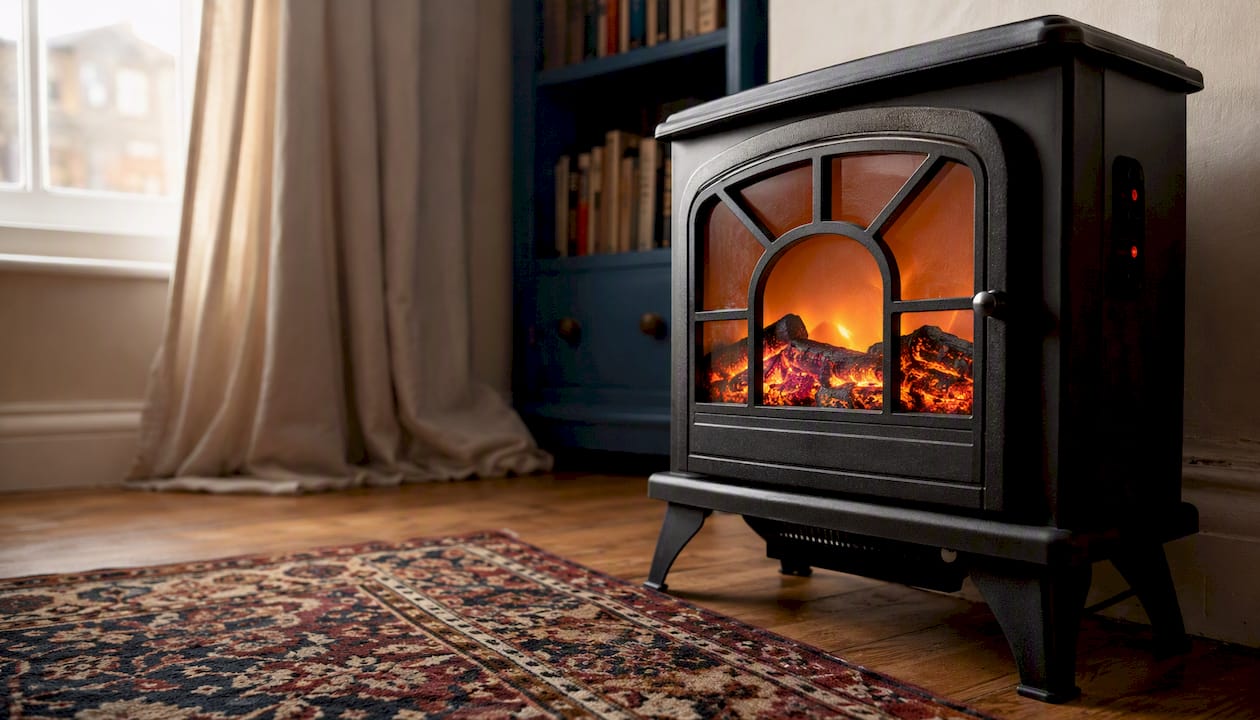
The Everhot electric heater mimics the look of a traditional cast-iron range, delivering radiant heat with a heritage aesthetic. It suits buyers who want something that looks as good as it heats. The Mill Gentle Air oil filled radiator brings Mill’s precise thermostat technology to an oil-filled format, combining the heat retention of oil with the scheduling accuracy of the Mill app.
Side-by-side comparison: which heater suits your situation?
Running-cost estimates use 24.5p/kWh as a representative UK unit rate. Your actual cost will vary with your tariff. As the Centre for Sustainable Energy explains, the formula is simple: heater kW × your pence/kWh rate = cost per hour.
All direct electric heaters convert electricity to heat at close to 100% efficiency. Running-cost differences between models come from heat retention, thermostat accuracy, and duty cycle — not from the element type itself.
| Model | Best for | Power (kW) | Est. room size | Price band | Running cost (p/hr) | Smart features | Noise | Portable / wall-mount | SSHEE note |
|---|---|---|---|---|---|---|---|---|---|
| Dimplex Q‑Rad RF panel | Whole-room smart heating | 1.5 | Up to 15 m² | Mid | 36.75 | RF + Wi‑Fi hub | Low | Wall-mount | Good thermostat alignment |
| Dimplex DX convector | Large rooms, fast heat | 2 | Up to 20 m² | Mid | 49 | Basic | Low–med | Both | Standard |
| Dimplex Thermo tubular | Bathroom/zonal | 0.06–0.12 | Zonal | Budget | 1.5–2.9 | None | Silent | Wall-mount | 6-hr limit applies |
| Mill WiFi Max 1500W | Smart schedule control | 1.5 | Up to 15 m² | Mid | 36.75 | Wi‑Fi + app | Low | Portable | Precise thermostat |
| Dreo Atom 316 / Solaris PTC | Quick bursts, desk/office | 1–2 | Up to 15 m² | Budget–mid | 24.5–49 | Some models | Med | Portable | PTC fast cut-off |
| Morphy Richards HeatFlux tower | Space-saving living room | 2 | — | Mid | 49 | Remote | Med | Portable | Standard |
| Russell Hobbs oscillating ceramic | Budget occasional use | 2 | Up to 15 m² | Budget | 49 | None | Med | Portable | Basic thermostat |
| Dyson Hot+Cool HP1 | Air purification + heat | 2.2 | Up to 20 m² | Premium | 53.9 | App + voice | Low | Portable | Premium controls |
| Beldray smart ceramic | Affordable smart heating | 2 | Up to 15 m² | Budget–mid | 49 | App | Med | Portable | App scheduling |
| VonHaus oil-filled 1,500W | Quiet bedroom warmth | 1.5 | Up to 12 m² | Budget | 36.75 | None | Silent | Portable | Heat retention |
| Duux Threesixty 2 | Family rooms, safety | 2 | Up to 15 m² | Mid | 49 | Limited | Low–med | Portable | Safety cut-outs |
| Devola smart glass panel | Design-led wall panel | 2 | — | Mid | 49 | Wi‑Fi + app | Low | Wall-mount | Smart controls |
| Dreamland Silent Power Pure Air | Multi-season small rooms | 2 | Up to 12 m² | Mid | 49 | Limited | Low | Portable | Filtration layer |
| Everhot electric | Heritage design, sustained | 2 | — | Premium | 49 | None | Low | Freestanding | Radiant |
| De’Longhi Capsule 1.8 kW | Compact desk/small room | 1.8 | Up to 10 m² | Mid | 44.1 | None | Med | Portable | Standard |
| Shark TurboBlade Cool + Heat | Year-round bladeless use | 2 | Up to 15 m² | Mid | 49 | Limited | Low | Portable | Standard |
| Aeno Premium Eco Smart LED | Smart wall-mounted panel | 1–2 | Up to 15 m² | Mid | 24.5–49 | App | Low | Wall-mount | Smart alignment |
| Dimplex DXBC22 ThermaIQ | Baseboard smart install | 1.5 | — | Mid | 49 | Smart thermostat | Low | Wall-mount | Smart controls |
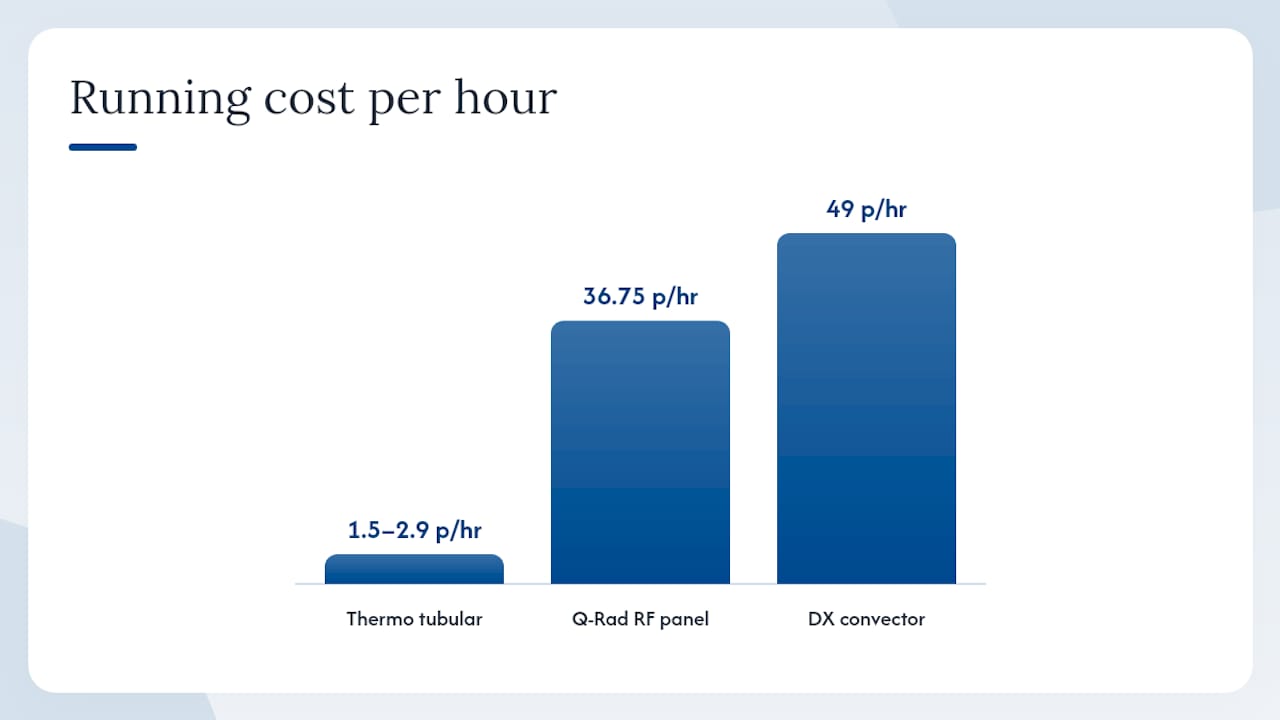
A note on the running-cost column: these figures assume the heater runs at full power for a full hour. In practice, a heater with a good thermostat will cycle off before the hour is up. A model with a precise electronic thermostat running at 60% duty cycle costs roughly 60% of the figure shown. That is why comparing heaters on duty cycle and room fit produces more useful buying decisions than comparing headline kW alone.
How to choose the right electric heater for your room
Sizing: how many kilowatts do you actually need?
The standard rule of thumb for UK rooms with average insulation is roughly 100 W per square metre. A 15 m² bedroom needs about 1.5 kW; a 25 m² open-plan living room needs 2.5 kW. Adjust upward for high ceilings, single-glazed windows, or poor insulation, and downward for well-insulated modern builds. The Heated Living sizing guide walks through this with worked examples including ceiling-height adjustments.
A worked example: a typical UK living room of 20 m² with standard insulation needs 2 kW. A bedroom of 12 m² with good insulation needs 1.2 kW — so a 1.5 kW model gives you headroom without over-specifying.
Selection checklist
- Measure the room in square metres and apply the 100 W/m² rule as a starting point.
- Decide on permanent or portable. Wall-mounted panels suit permanent rooms; portable heaters suit renters or rooms you use occasionally.
- Choose the right type for your usage pattern. Fan heaters warm a room in minutes; oil-filled radiators take longer but sustain heat quietly. More on types below.
- Check thermostat quality. A dial thermostat is imprecise. An electronic thermostat with 0.5°C resolution cuts wasted runtime materially.
- Look for a timer or scheduling function. Even a basic 24-hour timer prevents the heater running when the room is empty.
- Consider noise. Fan heaters are audible; oil-filled and panel heaters are near-silent. For bedrooms, silence matters.
- Check safety features. Tip-over cut-off, overheat protection, and child-lock are standard on quality models.
- Verify the warranty. UK consumer law gives you statutory rights, but a manufacturer’s warranty beyond 12 months signals build confidence.
- Ask about SSHEE compliance. The 2026 proposals set minimum seasonal space heating energy efficiency thresholds. A heater with electronic controls and a precise thermostat is more likely to meet them.
- Check the returns policy. Simcodirect offers 30 days; confirm the same with any retailer before buying.
Questions to ask before you buy:
- What is the room’s square meterage, and does this heater’s output match?
- Does it have an electronic thermostat or just a dial?
- Is there a timer or app scheduling?
- What is the warranty period, and who handles UK after-sales?
- Does the spec sheet reference SSHEE or ecodesign compliance?
- What is the retailer’s returns window?
Good heating system controls — timers, thermostats, and scheduling — reduce wasted running hours more reliably than any other single upgrade.
Running costs, efficiency, and what the 2026 UK ecodesign proposals mean
How to calculate your running cost
The formula is straightforward: heater kW × electricity rate (p/kWh) = cost per hour. At a typical UK rate of 24.5p/kWh:
- A 1 kW heater costs 24.5p per hour
- A 1.5 kW heater costs 36.75p per hour
- A 2 kW heater costs 49p per hour
- A 2.5 kW heater costs 61.25p per hour
Scenario 1 — short burst (30 minutes, 2 kW fan heater): 0.5 hours × 49p = 24.5p. Reasonable for warming a room before you sit down.
Scenario 2 — sustained evening use (4 hours, 1.5 kW panel with 60% duty cycle): 4 × 36.75p × 0.6 = 88.2p. That is the realistic cost for an evening’s background warmth in a well-insulated bedroom.
As the CSE’s room heater guidance makes clear, electric heaters are 100% efficient by conversion — every unit of electricity becomes heat. The practical question is how much electricity the heater actually draws over time, which is where thermostat quality and heat retention determine the real bill.
The 2026 SSHEE and ecodesign proposals
The UK government’s 2026 options assessment sets proposed minimum Seasonal Space Heating Energy Efficiency (SSHEE) thresholds for electric heaters. These are not yet law, but they signal the direction of product development and what to look for on spec sheets.
Key SSHEE thresholds proposed: portable electric heaters 44.7%; fixed electric heaters above 250 W 47.5%. These figures come from the GOV.UK local space heaters options assessment.
The draft statutory instrument also sets control requirements: some product types must include electronic thermostats, timers, or time-limited operation. Low-power towel rails at or below 60 W, for example, must include a 6-hour maximum pre-set time limit.
| Product category | Proposed minimum SSHEE |
|---|---|
| Portable electric heaters | 44.7% |
| Fixed electric heaters above 250 W | 47.5% |
| Fixed electric heaters at or below 250 W | To be confirmed |
| Electric storage heaters | Separate category |
What this means for buyers: a heater with an accurate electronic thermostat and scheduling is more likely to meet or exceed these thresholds in real-world use. A dial-thermostat model running at full power for long periods will not.
Pro Tip: When comparing smart heaters, look for models that advertise electronic thermostat resolution of 0.5°C or better. A heater that holds your target temperature precisely cycles off sooner and runs less — that is the mechanism behind a lower effective running cost, not the element type.
Combining a well-chosen heater with energy-efficient window treatments reduces heat loss and cuts the heater’s duty cycle further. For outbuildings and garden rooms, proper insulation delivers far better long-term savings than increasing heater output.
How we tested and ranked these heaters
Every model in this guide was assessed against the same set of criteria, structured around the axes that recent 2025–26 buyer roundups consistently identify as most important: energy efficiency, noise, build quality, and smart controls.
Testing checklist:
- Energy controls: — presence and quality of timer, scheduling, and thermostat resolution
Rating scale: models are rated across the testing criteria above. The verdict for each model reflects the balance of those scores weighted by the primary use case — a bedroom heater is judged more on noise and thermostat accuracy; a living-room heater more on output and heat distribution.
Editorial review: all picks are reviewed against buyer guidance from Ideal Home and the HomeHeatingHQ cost guide to cross-check our assessments against independent testing.
Final verdict: which heater should you buy?
Scenario-based buying decisions are more useful than a single “best overall” pick, because the right heater depends entirely on the room and how you use it.
- Bedroom: VonHaus oil-filled radiator 1,500W or Mill WiFi Max 1500W. The VonHaus is silent and retains heat through the night; the Mill adds scheduling so the room is warm when you wake up.
- Home office: Dreo Atom 316 or De’Longhi Capsule 1.8 kW. Both warm a small room quickly and sit unobtrusively on a desk or floor.
- Bathroom: Dimplex Thermo tubular heaters or a dedicated electric towel radiator. The tubular format is bathroom-safe and costs pennies per hour for background warmth. A Titan Chrome Straight Towel Radiator or Platinum Chrome Electric Curved Towel Radiator from Simcodirect adds warmth and towel drying in one.
- Large living room: Dimplex DX convector heater or Devola 2.5 kW oil filled radiator. The DX convector heats fast; the Devola sustains warmth quietly for longer sessions.
- Rental or portable use: Russell Hobbs oscillating ceramic 2 kW or Morphy Richards HeatFlux tower. Both are freestanding, need no installation, and are available at most UK retailers.
On delivery and arrival: most UK retailers ship electric heaters within 2–5 working days. On arrival, check the warranty card is included, test all controls before the returns window closes, and read the installation notes if the model is wall-mountable. For bathroom installations, verify the IP rating on the spec sheet before fixing.
What type of electric heater do you actually need?
The type of heater matters less than most buyers think, but it does determine how quickly a room warms up and how quietly it does so.
Fan heaters (Dreo Atom, Russell Hobbs ceramic, Morphy Richards HeatFlux, De’Longhi Capsule, Shark TurboBlade, Dreamland Silent Power) blow air over a heated element. They warm a room in minutes, which makes them ideal for short bursts. The trade-off is fan noise and the fact that heat disappears quickly once the unit is off.
Convector heaters (Dimplex DX, Mill WiFi Max) draw cool air in at the base, heat it over an element, and release warm air from the top. Quieter than fan heaters and better for sustained use, though they take a few minutes longer to get going.
Oil-filled radiators (VonHaus 1,500W, Devola 2.5 kW, Dreo oil filled radiator, Mill Gentle Air) heat thermal fluid that continues radiating after the element cycles off. This heat retention means they spend more time off at lower average power for sustained use — the reason they tend to cost less per evening than fan heaters of the same wattage. Slow to reach temperature; not suited to quick warm-up needs.
Panel heaters (Dimplex Q‑Rad RF, Devola smart glass panel, Aeno Premium Eco Smart LED, Dimplex DXBC22 ThermaIQ) are wall-mounted and combine convection with some radiant output. They suit permanent installations and work best with a precise thermostat. The infrared bathroom heater guide covers the radiant panel variant in detail.
Radiant and stove-style heaters (Everhot, VonHaus Electric Stove & Log Store) emit direct radiant heat rather than warming the air. They heat objects and people in their line of sight quickly, but do not warm the whole room evenly. The stove-style format adds a decorative element that suits living rooms.
Storage heaters are a separate category: they charge on off-peak electricity overnight and release heat through the day. They suit homes on Economy 7 or similar time-of-use tariffs and are not covered in this portable/plug-in guide.
Safety certifications you should check before buying
The UKCA mark (UK Conformity Assessed) replaced the CE mark for products placed on the Great Britain market after 1 January 2023. Any electric heater sold new in the UK should carry the UKCA mark on the product or its packaging, confirming it meets the relevant UK product safety standards.
For electric heaters, the key standards cover electrical safety (protection against electric shock, insulation, and earthing), thermal safety (overheat cut-off, surface temperature limits), and electromagnetic compatibility. The UKCA mark confirms the manufacturer has assessed the product against these requirements.
What to check on the spec sheet or packaging:
- UKCA mark (mandatory for new products on the GB market)
- IP rating for bathroom models (minimum IP21 for Zone 3; IP44 or above for Zone 2)
- Tip-over cut-off (standard on freestanding models; verify it is present)
- Overheat protection (thermal cut-out)
- Child-lock (relevant for family homes; present on Duux Threesixty 2 and some Dreo models)
For bathroom installations specifically, the IP rating is not optional. A heater without the correct IP rating for its intended bathroom zone is a safety risk. The radiator placement guide covers bathroom zone requirements in practical detail.
Key takeaways
The most effective way to reduce electric heater running costs is to match the heater’s wattage to the room size and choose a model with a precise electronic thermostat that limits unnecessary runtime.
| Point | Details |
|---|---|
| Top pick for most homes | The Dimplex Q‑Rad RF panel radiator offers smart control, wall-mount format, and 1.5 kW output for rooms up to 15 m². |
| Running cost formula | Heater kW × pence/kWh = cost per hour; a 2 kW heater at 24.5p/kWh costs 49p per hour at full power. |
| Thermostat beats wattage | A precise electronic thermostat reduces duty cycle and cuts real running costs more than choosing a lower-wattage model with a dial. |
| 2026 SSHEE thresholds | Proposed minimums are 44.7% for portable heaters and 47.5% for fixed heaters above 250 W; look for electronic controls on spec sheets. |
| Simcodirect stock | Simcodirect stocks the Dimplex Q‑Rad RF, DX convector, and Thermo tubular ranges with 30-day returns and fast UK delivery. |
A retailer’s honest view on buying electric heaters
The most common mistake is buying too much heater. A customer picks a 2 kW model for a 10 m² bedroom because it feels like better value, then wonders why the electricity bill is higher than expected. The heater is not faulty — it is simply oversized for the room, so the thermostat never gets a chance to do its job properly. The room hits temperature fast, the heater cycles back on almost immediately, and the duty cycle stays high all evening.
The second mistake is ignoring the thermostat. A dial thermostat on a budget heater is essentially a guess. An electronic thermostat with 0.5°C resolution holds the room at the temperature you set, cycles off cleanly, and stays off until the room actually drops. Over a winter, that precision is worth more than any headline feature.
From a stock perspective, the Dimplex range sits at a sensible point: proven build quality, UK warranty support, and smart controls that work without requiring a degree in app configuration. The Q‑Rad RF in particular is the model we recommend most often to customers who want a permanent solution that does not look like an afterthought.
Useful sources and official guidance
The sources below are the primary references for the regulatory data, running-cost figures, and testing methodology in this guide. All reflect 2025–2026 regulatory developments.
- Updating minimum energy performance standard for local space heaters: options assessment (accessible webpage) — GOV.UK
- Room heaters | Centre for Sustainable Energy
- 5 things I wish I knew before buying an electric heater | Ideal Home
- Cheapest electric heaters to run UK (2026 cost guide) | HomeHeatingHQ
- How to size an electric heater for your UK room | Heated Living
- Heating option comparison calculator (UK) | Home Energy Scout
- Best electric heaters UK: tried and tested in real homes | Ideal Home